
“What Do You Mean We Haven’t?” The Fiftieth Anniversary of Kentucky’s Ratification of the Reconstruction Amendments
“You mean we haven’t ratified those?” state senator John Lackey of Richmond asked in a moment of bewilderment.1 It was March 1976, the nation’s bicentennial year, marking the two hundredth anniversary of the signing of the Declaration of Independence and the birth of the United States. Lackey’s comments were in response to learning that Kentucky had never ratified the Reconstruction Amendments: the Thirteenth Amendment, which outlawed slavery; the Fourteenth that extended citizenship to those born or naturalized in the United States (except Native Americans); and the Fifteenth that guaranteed voting rights to all American citizens regardless of race. These three amendments were made law in the aftermath of the U.S. Civil War, between 1865 and 1870. They redefined the nature of the constitution, expanding the power of the federal government, and transformed the American body politic almost overnight by emancipating and enfranchising millions of formerly enslaved people.
Yet, Kentucky, a loyal Union state, never ratified them.
Kentucky’s failure to ratify the amendments resides in the state’s messy war experience and postwar memory. Most white Kentuckians supported the Union at the outset of the Civil War, but that support was vested in the belief that remaining loyal was the best way to preserve slavery in the commonwealth. Yet, over the course of the war public opinion soured as wartime realities shifted. The destruction of slavery, a brutally hard-fought war, and fractious political disagreements eroded confidence in Washington and the Union war effort.
Thomas E. Bramlette’s sentiments, the third and last Union wartime governor, exemplified how most Kentuckians felt about the Civil War. Bramlette went to war as an ardent Unionist, intent on preserving the nation as it was before Abraham Lincoln’s election: with the Union and slavery intact. As the war progressed, it became abundantly clear that the path to Union victory would require the destruction of slavery. To weaken the Confederacy’s ability to make war, Lincoln issued his Emancipation Proclamation (EP) in 1863, which struck a blow at the core of the Confederacy’s economy—slavery. Although admitted from the proclamation legally, the practical impact of the EP extended to loyal, pro-slavery border states, such as Kentucky. Kentuckians, Bramlette included, spent the back half of the war fuming at this ideological shift. They protested Black enrollment in the U.S. Army, which the Emancipation Proclamation opened the door to, and complained about perceived federal interference in their elections and the war’s all-consuming, seemingly endless violence.
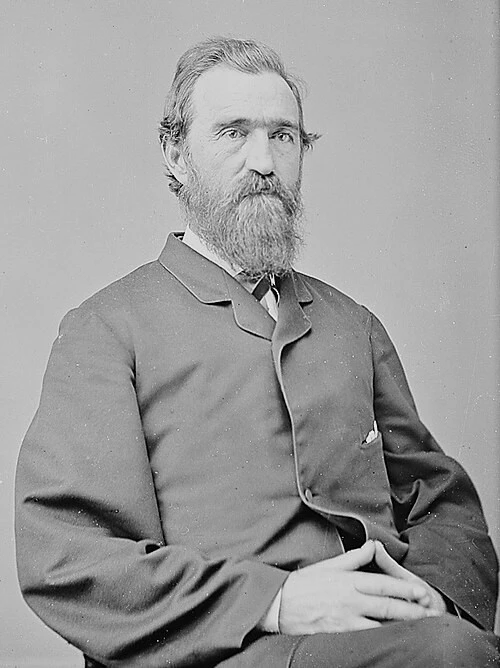
Portrait of Hon. Thomas E. Bramlette, by Matthew Brady ca. 1860–1865. Id. Num.: 529992, Record Group 111, Mathew Brady Photographs of Civil War-Era Personalities and Scenes, U.S. National Archives and Records Administration, Washington, D. C.
In early 1865, to ensure the erasure of slavery, Congress passed the Thirteenth Amendment, endling slavery in the United States, except as punishment for a crime. While Bramlette frequently, and bitterly, bemoaned the consequences of the war, including the erosion of slavery, he encouraged Kentuckians to ratify the Thirteenth Amendment.2 An enslaver himself, Bramlette’s about-face might seem contradictory to his position during the war, but it was calculated. The war had destroyed slavery. It was “one of the inexorable and irreversible conclusions” of the conflict, he argued.3 Further, Bramlette admitted that freedom was natural and national, thus the purview of the federal government to administer instead of individual states. Rather than resist, Bramlette encouraged Kentucky’s legislature to ratify the amendment, arguing that “Franchises other than freedom are political, not natural.” In other words, Bramlette stressed that if Kentuckians, and other white Southerners, proved hostile to emancipation, they would incur Washington’s ire and likely more interference in their internal affairs. Bramlette pointed out that “the adoption of the proposed amendment will give to us perpetual indemnity against the attempt to control the question of suffrage through the federal power.”4 Put more bluntly, Bramlette suggested that if Kentuckians conceded the death of slavery, they could curtail African American rights without federal interference.
Kentucky’s legislators disagreed with Bramlette’s argument and rejected the amendment. Other Southern states also resisted the postwar expansion of African American freedom. Former Confederates and white supremacists across the region attempted to curtail African Americans’ rights, either through intimidation, violence, or legislation. Frustrated by the perceived backsliding of Reconstruction, Congressional Republicans waged a legislative war against defiant white Southerners. Not only did Congress wield its power to occupy the South militarily and dismantle rural insurgents, like the Ku Klux Klan, they also passed the Fourteenth and Fifteenth Amendments in 1868 and 1870 respectively, intent on sustaining Black freedom and the voting rights of African American men.
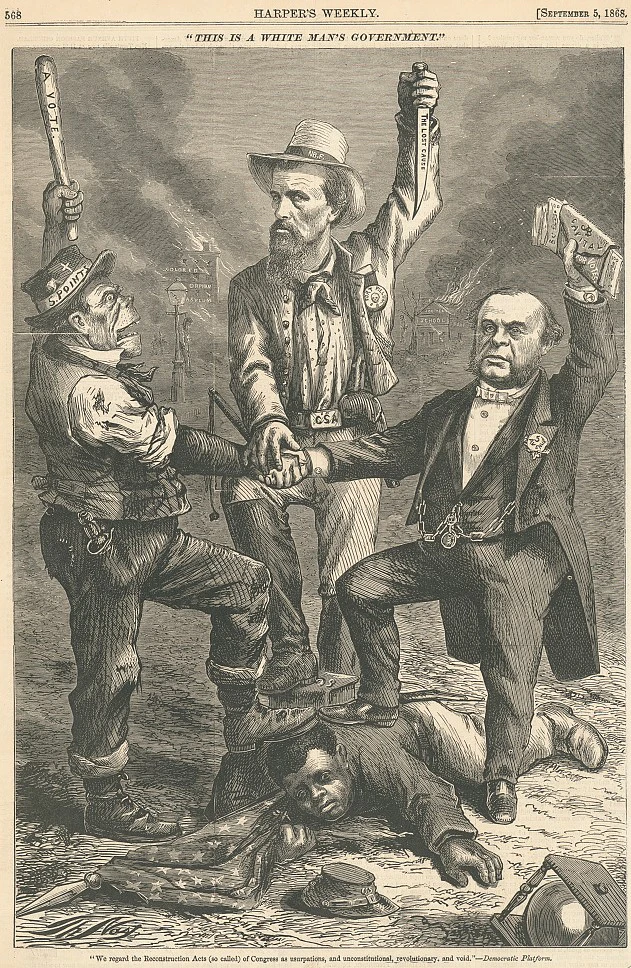
Wood Engraving, “This is a white man’s government,” by Thomas Nast, 1868. This print appeared in an issue of Harper’s Weekly on September 5, 1868. Call Num.: AP2.H32, Library of Congress Prints and Photographs Division, Washington, D.C.
While Kentucky did not experience legal Reconstruction like former Confederate states, it did face many of the same challenges as its citizens adjusted to the new postwar sociopolitical order. Whereas states like Virginia, Mississippi, or Alabama had seceded to join the Confederacy, Kentucky never left the Union and, thus, its wartime loyalty limited Congressional oversight in the state. Moreover, the Democratic party was not weakened in Kentucky as it had been in other states because of the war. In this way, the commonwealth looked more like other slaveholding border states, such as Delaware, Maryland, Missouri, and West Virginia. In these states, returning Confederates united with Democrats who opposed Lincoln and the Republican Party. In Kentucky, for instance, Bramlette, a life-long foe of the Democratic Party, joined with his old enemies in 1868, signing a platform that called for “the RESTORATION of the Southern States, and the establishment of the principle that this is the white man’s government.”5
Many white Kentuckians shared Bramlette’s belief and unleashed a wave of violence to curtail Black freedom and citizenship. As a result, lingering guerrilla violence and an increase in lynchings plagued Bramlette and future governors. In fact, historian George Wright notes that from 1865 to 1940, white Kentuckians lynched over 350 Black Kentuckians. One-third of those lynchings occurred between 1865 and 1874.6 This number, Wright admits, is an undercount, as many lynchings were covered up and improperly documented. Scholars also inconsistently define the nature of what a lynching qualifies as. This is not to mention the numerous other instances of racial violence and discrimination white Kentuckians perpetrated against Black communities in the years after the war to limit their freedoms.
The memory of the Civil War in Kentucky and the tumultuous period that followed has been twisted and infused with Lost Cause mythology. White Kentuckians, according to historian Anne Marshall, crafted a narrative of victimhood that allowed them to sympathize and ally with former Confederates after the war.7 They did so also out of dissatisfaction with the destruction of slavery, federal occupation, and Black Americans’ enfranchisement.
Twentieth century historians perpetuated the myth of a Confederate Kentucky. Some reinforced the state’s Southern sympathies, ignoring the early enthusiasm for the Union that sustained men like Bramlette, future supreme court justice John Marshall Harlan, and nearly 100,000 Kentuckians, white and Black, who fought for the United States. Others argued that slavery and postwar racial violence in Kentucky was milder than in other slaveholding states.8 As a result, many white Kentuckians forgot their state’s Civil War history.
But not everyone forgot.
In 1976, as Kentucky’s legislature debated the Equal Rights Amendment—a proposed Twenty-seventh Amendment to the U.S. Constitution that would guarantee equal rights regardless of gender—Mae Street Kidd reminded John Lackey and other legislators that Kentucky still had not passed the Reconstruction Amendments. Kidd, one of three African American legislators, had lived her life in the shadow of Kentucky’s Civil War memory. Born in 1904, Kidd grew up during the height of Jim Crow in the commonwealth. The same year she was born, Kentucky legitimized “separate but equal” education in the “Day Law.” When Kidd was a teenager, she saw women receive the right to vote via the Nineteenth Amendment, perhaps wondering if those rights would ever be granted to her as a woman of color. As an adult, Kidd experienced firsthand the Civil Rights movement and Black Kentuckians fight for voting rights, an integrated education system, and an end to redlining in the state. She witnessed Martin Luther King’s “March on Frankfort” in 1964 and the state’s ratification of the Equal Rights Amendment in 1972.
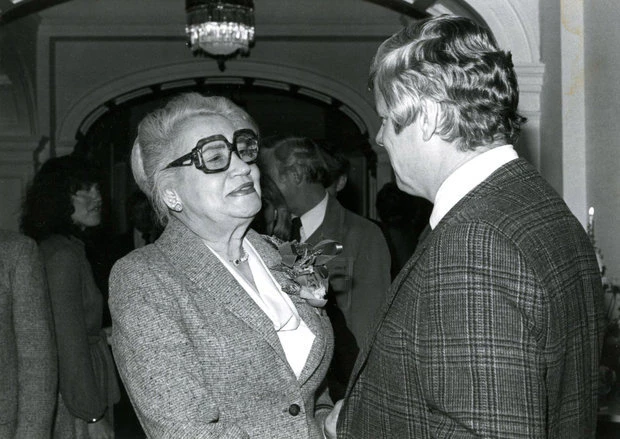
Mae Street Kidd at Governor’s Mansion Reception with Gov. John Y. Brown Jr., ca. 1979–1983. Public Domain.
And yet, through all this progress, the very amendments that determined Black Kentuckians were free citizens and entitled to voting rights remained shelved, unratified, and a forgotten fixture of the state’s Civil War memory.
On March 18, 1976, the Kentucky legislature unanimously ratified the Reconstruction Amendments. The vote was a symbolic gesture for those amendments had been law for over a century. Yet, their ratification, even if symbolic, mattered to Black Kentuckians, such as Mae Street Kidd. The fact that they had remained unratified for so long embodied the stain of the war and slavery that still soiled the commonwealth. To ratify them, was to finally reconcile, to a degree, with Kentucky’s complicated Civil War experience and memory. It signaled hope to Black Kentuckians that while slow, change could occur.
As we reflect on American and Kentucky history amid the two-hundred and fiftieth anniversary of the Declaration of Independence, we must be reminded of the constant effort that it takes to make our nation work. It is not perfect, despite the solemn words of the Declaration and the Constitution. If we continue to pursue the ideals of our founding documents, no matter how long that pursuit may last, we may achieve the more perfect Union that the framers of the Reconstruction Amendments had in mind when they carved them into the Constitution more than a century and a half ago.
Coming next month:
How did a Civil War battle in Kentucky in 1862 influence a presidential election almost twenty years later? Learn about James Garfield and the Battle of Middle Creek in our next blog.
Additional references:
Eric Foner, Reconstruction: America’s Unfinished Revolution, 1863–1877 (HarperCollins, 1988).
——. “The Reconstruction Amendments: Official Documents as Social History,” History Now, no. 2 (Winter 2004), https://www.gilderlehrman.org/history-resources/essays/reconstruction-amendments-official-documents-social-history.
“Reconstruction: A Resource Guide,” Research Guides, Library of Congress, https://guides.loc.gov/reconstruction/external-websites.
Stacey L. Holman, dir., Reconstruction: American After the Civil War (Public Broadcasting Service, 2019), https://www.pbs.org/show/reconstruction-america-after-civil-war/.
Ross A. Webb, Kentucky in the Reconstruction Era (Kentucky Historical Society, 1979).
Charles L. Davis, “Racial politics in Central Kentucky during the Post-Reconstruction Era: Bourbon County, 1877–1899,” The Register of the Kentucky Historical Society 108, no. 4 (Autumn 2010): 347–82.
Patricia A. Hoskins, “The Freedmen’s Bureau in the Jackson Purchase Region of Kentucky, 1866–1868,” The Register of the Kentucky Historical Society 111, no. 3 & 4 (Summer/Autumn 2012): 503–32.
NOTES
[1] “General Assembly official ratifies 13th amendment,” The Paducah (Ky) Sun, 19 March 1976, p. 5.
[2] Thomas E. Bramlette, Message to the General Assembly of Kentucky, December Session, 1865, 4 December 1865, Office of the Governor, Thomas E. Bramlette: Governor's Official Correspondence File, Messages to the General Assembly, 1863–1867, BR1-320 to BR1-333, Kentucky Department for Libraries and Archives, Frankfort, accessed via the Civil War Governors of Kentucky Digital Documentary Edition, discovery.civilwargovernors.org/document/KYR-0001-008-0002.
[3] Bramlette, Message to the General Assembly of Kentucky, December Session, 1865, 15.
[4] Bramlette, Message to the General Assembly of Kentucky, December Session, 1865,16–17.
[5] Untitled, Louisville (Ky) Journal, 10 January 1868, p. 1.
[6] George C. Wright, Racial Violence in Kentucky, 1865–1940: Lynchings, Mob Rule, and “Legal Lynchings,” (Louisiana State University Press, 1990), 1–5.
[7] Anne E. Marshall, Creating a Confederate Kentucky: The Lost Cause and Civil War Memory in a Border State (University of North Carolina Press, 2010).
[8] E. Merton Coulter, Civil War and Readjustment in Kentucky (University of North Carolina Press, 1926) and J. W. Coleman, Slavery Times in Kentucky (University of North Carolina Press, 1940).
