
Civil War History Day 2025 Debrief
From 25 to 27 September 2025, the Kentucky Historical Society (KHS) hosted an in-person workshop for history graduate students as well as its third annual Civil War History Day.
Both programs were extensions of KHS’s mission to engage public audiences and use those opportunities to prepare them to meet the challenges of the future. The graduate students—eleven in total from Arkansas, Georgia, Kentucky, Illinois, Indiana, New York, North Carolina, Virginia, and West Virginia—came to KHS as part of the Public & Applied History Symposium on the Civil War Era. Supported by the Society of Civil War Historians (SCWH) through its bi-annual mini-conference grant and America 250 Kentucky, the symposium connected students with museum and public history professionals and allowed them to experience on-the-ground interpretation of Civil War Kentucky at KHS’s Thomas D. Clark Center for Kentucky History and at historical sites across central Kentucky.
KHS was motivated to host this symposium because of the Civil War Governors of Kentucky Digital Documentary Edition’s (CWGK) success working with and mentoring graduate students. Since 2016, CWGK has hired over thirty Remote Graduate Research Associates (GRAs), who help the editorial team create and research biographies of Civil War Kentuckians as well as transcribe and code historical documents for publication on the CWGK website. CWGK and KHS see the value in working with future historians both through the GRA program and onsite in Kentucky. Not only will the future of historical interpretation involve digital projects like CWGK, but it also needs to engage public audiences on important topics, such as the Civil War in Kentucky. Furthermore, hosting the students and the symposium allowed KHS to continue its role as a leader in helping people understand Kentucky history.
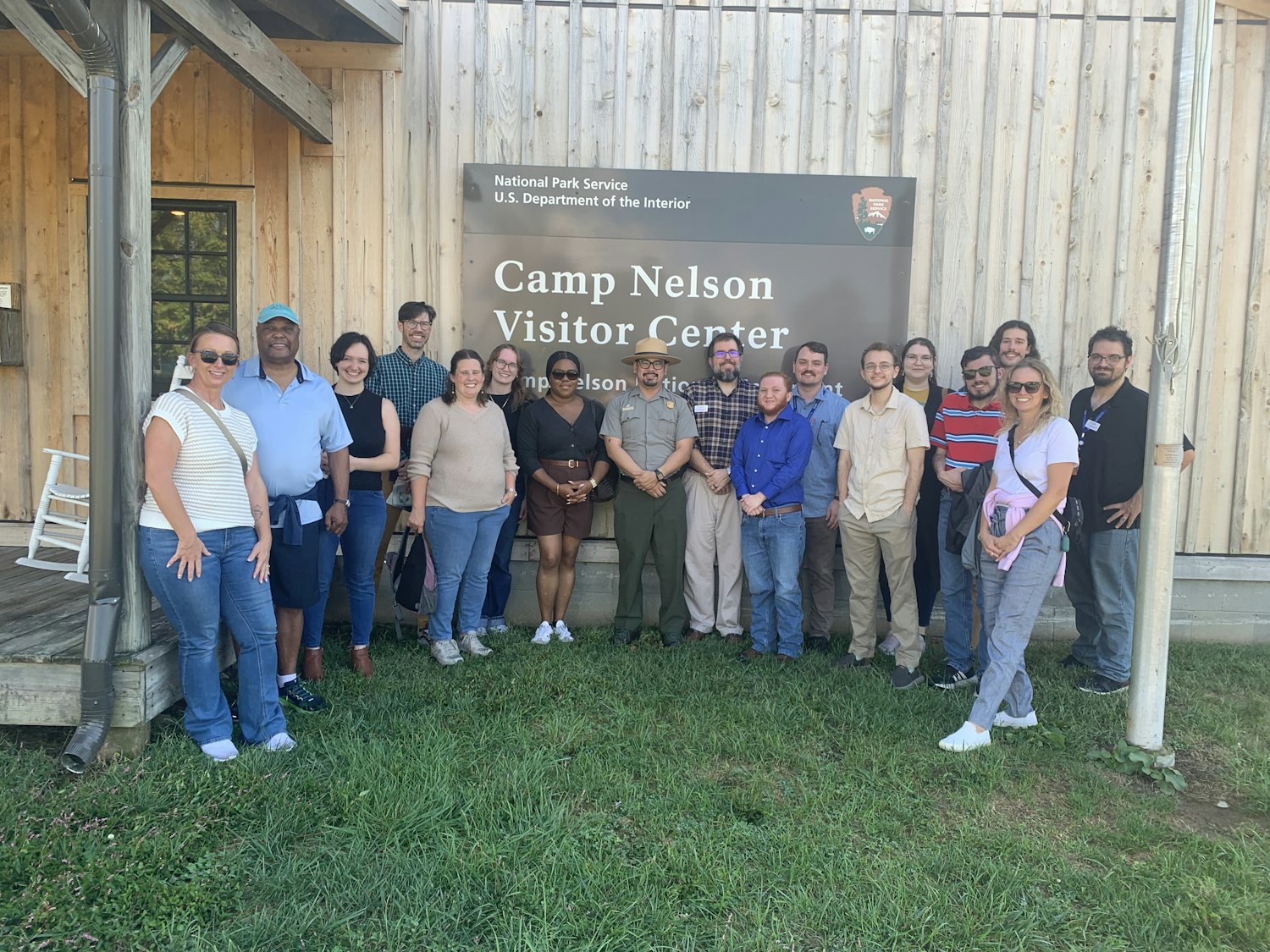
[Ill. 1. Public & Applied History Symposium Students Pose for a Photograph with NPS Ranger Steve T. Phan. Photograph by Charles R. Welsko, September 26, 2025, Camp Nelson National Monument, Nicholasville, Kentucky.]
On Thursday, 25 September, the graduate students spent the day in downtown Frankfort at the Clark Center. Their time onsite included meetings and conversations with collections staff, tours of object and archival storage, discussions about administrative work and museum leadership, and a conversation about academic publishing with the editors of The Register of the Kentucky Historical Society. The highlight of the event was a discussion of KHS’s exhibit spaces, focusing on potential improvements or redesigns of the Civil War and Reconstruction sections of that permanent exhibit. The following Friday, the symposium traveled to Camp Nelson National Monument, the Lexington History Museum, and the Blue Grass Trust for Historic Preservation. At each site, the students toured exhibits, met with staff, and learned about the work of public historians. The visits to these three sites demonstrated the various ways different institutions interpret Kentucky history and how public historians apply their craft across local, state, and national institutions.
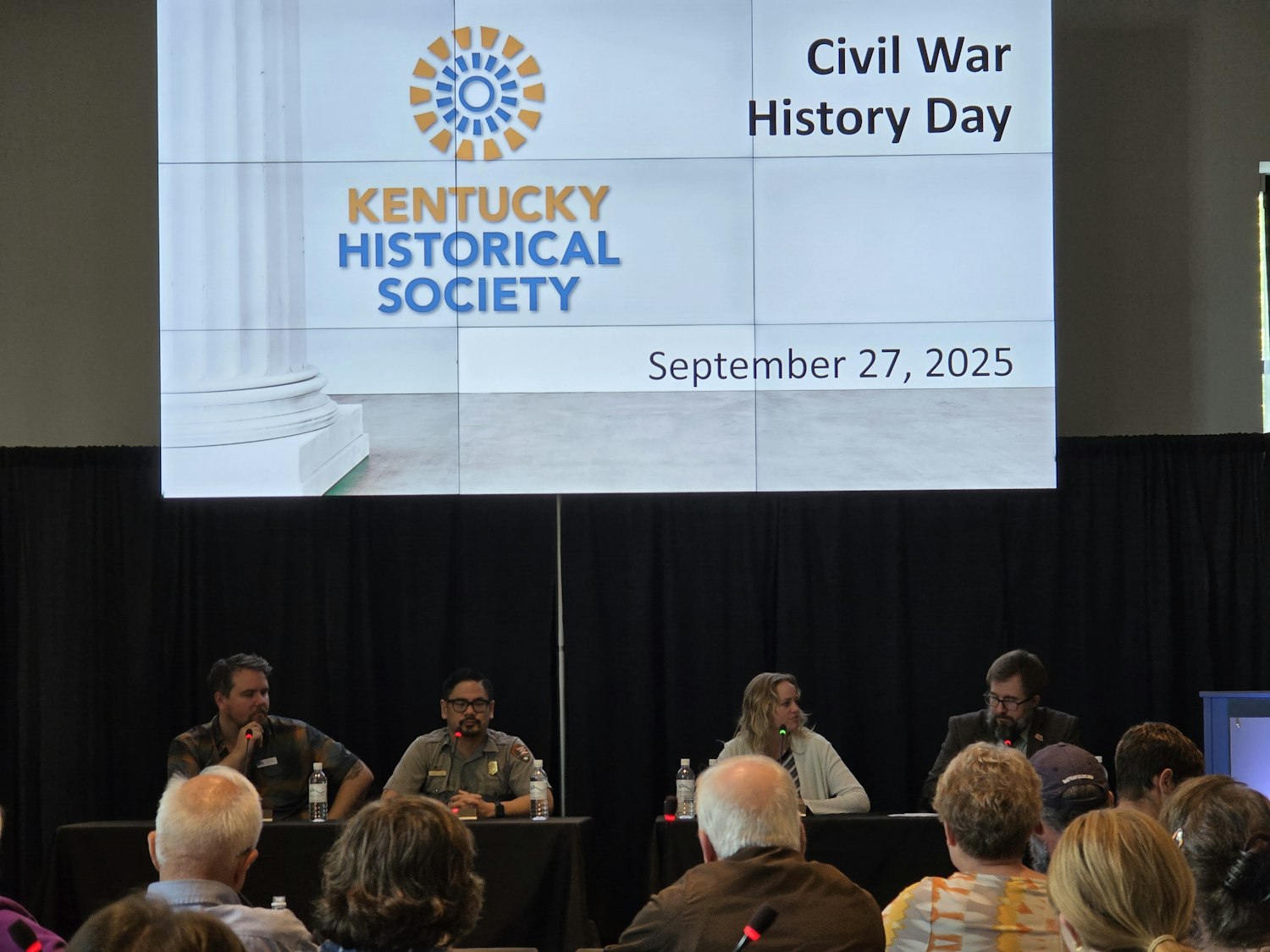
[Ill. 2. Left to Right, John Walker (Liberty Hall), Steve T. Phan (NPS: Camp Nelson), Dr. Shae Smith Cox (Texas A&M), and Dr. Charles R. Welsko (KHS) discuss public history and museum interpretation at Civil War History Day, September 27, 2025. Photograph by Chase H. McCarter, Kentucky Historical Society, Thomas D. Clark Center for Kentucky History, Frankfort. ]
The symposium culminated in the third annual Civil War History Day (CWHD) hosted at the Clark Center on Saturday, 27 September. KHS brought together multiple historians to discuss Civil War Kentucky, including Brian McKnight (UVA Wise), who spoke about guerrilla violence in Appalachia, and Cicero M. Fain III (Marshall University), who highlighted the rise of Jim Crow and racial violence in postwar Kentucky. A roundtable with Shae Smith Cox (Texas A&M), Steve Phan (Camp Nelson National Monument), and John Walker (Liberty Hall Historic Site) highlighted how historians at universities, local museums, and National Park Service sites engage with Civil War history in different ways, reaching a wider range of audiences. Anne Marshall (Executive Director, U.S. Grant Presidential Library/Associate Professor, Mississippi State University), gave the day’s keynote about her new book, Cassius Marcellus Clay: The Life of an Antislavery Slaveholder and the Paradox of American Reform. Her presentation highlighted Clay’s complexities and contradictions as a slaveholding emancipationist in Civil War era Kentucky. While his contemporaries and many historians have viewed Cassius M. Clay as an atypical antislavery advocate, Marshall’s talk and book argue that he represented a far more common antislavery mindset than we have previously assumed.

[Ill. 3 Portrait of Cassius M. Clay in Diplomatic Dress Uniform, c. 1865. Catalogue Number 1881.1abc, Cassius M. Clay Collection, Kentucky Historical Society, Frankfort.]
This year, KHS also recorded CWHD lectures and discussions. They are available on our YouTube Channel for anyone to engage or revisit. CWHD provided guests with the opportunity to engage with these historians and their expertise on the Civil War era. It also allowed guests to interact with KHS’s resources, including Cassius Clay’s Chapeau-bras and a revolver used by Pt. Vincent Flener of the 52nd Kentucky Mounted Infantry Regiment during the Civil War. With the success of the symposium and Civil War History Day, it’s not too early to say that we will be back again next year for the fourth annual CWHD. Keep your eyes peeled for more information about next year’s CWHD in late September 2026. We’ve heard reports of marauding bands across the state and unsavory characters lurking in the shadows that we’d like to bring to light.
Coming next month:
Was the “Great Compromiser” beloved by all Kentuckians? Find out in our next blog, which delves into social and civic life in Henry Clay’s Kentucky.
Suggested Readings:
Anne E. Marshall, Cassius Marcellus Clay: The Life of an Antislavery Slaveholder and the Paradox of American Reform (University of North Carolina Press, 2025).
Brian McKnight, Contested Borderland: The Civil War in Appalachian Kentucky and Virginia (University Press of Kentucky, 2006).
Cicero M. Fain III, Black Huntington: An Appalachian Story (University of Illinois Press, 2019).
John Walker, “Blog: Our Southern Silver,” Liberty Hall Historic Site, https://libertyhall.org/blog/our-southern-silver.
Shae Smith Cox, The Fabric of Civil War Society: Uniforms, Badges, and Flags, 1859–1939 (Louisiana State University Press, 2024).
