
A New Life for KHS's USCT Muster Roll
Measuring over two feet high and three feet wide when fully open, the United States Colored Troops (USCT) muster and descriptive roll for Kentucky’s 7th, 8th, and 9th Congressional Districts is among the most treasured items in the Kentucky Historical Society’s (KHS) collection.
The ledger book that comprises the muster and descriptive roll requires a feat of strength to even pull out of its drawer. Its gargantuan size is not the only impressive feature of this rare book—the information it contains renders it an incredibly valuable source on the lives of Black Kentuckians who served in the Federal Army during the U.S. Civil War.
Following Abraham Lincoln’s Emancipation Proclamation, the War Department established the Bureau of Colored Troops on May 22, 1863, to facilitate the recruitment of African American soldiers into the Federal military. Thousands of Black men from across the country enlisted, forming infantry, cavalry, and artillery regiments led by white officers. Black men could serve as non-commissioned officers but were largely barred from the commissioned officer’s corps except for a select few. These United States Colored Troops included both free men of color and refugees from slavery, who often brought their families with them to Federal recruiting posts.1
The first Black enrollment efforts in Kentucky began in 1864, primarily at Camp Nelson. Located about six miles south of Nicholasville, the Federal military established the camp in 1863 and named it after Gen. William “Bull” Nelson who was murdered in Louisville in 1862 by fellow Federal general Jefferson C. Davis. The camp initially served as a supply depot and staging ground for the Federal Army’s operations in the region.
During the summer and fall of 1864, hundreds of formerly enslaved men and free men of color, with their families in tow, began arriving at Camp Nelson to enroll in the Federal Army. They formed several regiments, including the 12th and 13th USC Heavy Artillery, 5th and 6th USC Cavalry, and 114th and 116th USC Infantry. By the end of the war, Camp Nelson represented the third-largest recruitment center for Black soldiers in the country, having enlisted over ten thousand men.

Belt Buckle Found at Camp Nelson, ca. 1864. Catalog Num. IL9-2010.2, Kentucky Historical Society, Frankfort. Courtesy W. S. Webb Museum of Anthropology, University of Kentucky, Lexington.
When men arrived at the camp to enlist, officers recorded their information in ledger books like the one held by the Kentucky Historical Society. Our “USCT muster roll” includes each man’s name, birthplace, age, occupation, physical description, and information about when and where he enlisted. It also includes the name of each soldier’s enslaver, the name of the person who consented to the soldier’s enlistment, and sometimes the name of the unit or regiment the soldier joined. This information is what makes our USCT muster roll so valuable. Rarely do historians find such granular details about Black Kentuckians from this period; details about those who were enslaved in Kentucky are even rarer.

Pages from United States Colored Troops Muster and Descriptive Roll for Kentucky’s 7th, 8th, and 9th Districts, ca. 1864–1865. Catalogue Num. FF1.153, Kentucky Historical Society, Frankfort.
This volume has been in the Kentucky Historical Society’s rare book collection for decades, but it is unclear how it originally came to the society. An external wrapper identifies the book as “Volume 4,” and its pages only include information for men who enlisted from counties in Kentucky’s 7th, 8th, and 9th Congressional Districts.2 This implies that our volume is one of several that were used at Camp Nelson; however, the locations of other volumes is unknown.
It is difficult to put our USCT muster roll on exhibit or take it out frequently for researchers due to its large size and fragile binding. However, it was an ideal candidate for digitization because of its historical significance and research value. In the fall of 2022, I undertook a project to fully digitize the entire USCT muster roll, taking care to scan each page as a “full opening,” so that both the left-hand and right-hand pages would render in one image. This allows for the ledger to be read as it was intended to be used, with each man’s information contained in a single row that spans both pages.
I also scanned the pages at a high resolution so users could zoom in on the text. Most of the recruits were illiterate and signed their enlistment papers with a mark or “x.” Officers filling out the ledger also often wrote hastily or used abbreviations, so a closer look is sometimes necessary to decipher nearly illegible names, signature marks, and notes. The fully digitized USCT muster roll is now freely available in the Kentucky Historical Society’s Digital Collections for anyone to use. You can view it for yourself here.
Fully digitizing the muster roll creates a host of possibilities to make its data more accessible and useful. KHS’s Virtual Volunteers spent over 162 hours transcribing every line of the digitized ledger.3 Once edited, this information can be used to create data visualizations of the soldiers’ demographics or a searchable database of USCT soldiers from Kentucky. Researchers can cross-reference the information in the muster roll with other sources such as censuses, military records, and the 1850 and 1860 Slave Schedules in order to learn more about these men. And perhaps best of all, the individual stories of these soldiers can finally be told.
Inspired by my work with the USCT ledger, I decided to explore Frankfort Cemetery on a beautiful fall afternoon in November 2025 to see if I could find any USCT soldiers buried there. I knew I had seen one or two graves before, such as one belonging to “Leander Bramblette” (his story is one that deserves its own blog post), but I never investigated further. I made my way along the Glenns Creek or “GC” section of the cemetery—the area historically reserved for people of color. As I walked, I was excited to find USCT headstones every few feet, identifiable by the engraved shield surrounding their lettering. I counted no less than eleven soldiers buried in that section, and there are likely several more.4
I took photos of each headstone and noted each man’s name, company, and regiment. When I returned to my office, I looked through the USCT ledger for these soldiers. Incredibly, I found seven of them. From the muster roll, I obtained a general sense of what each man looked like, as their height, complexion, eye color, and hair color were all recorded. Other details jumped out at me as I read:
George Ellis was enslaved by E. H. Taylor—the uncle of Edmund Haynes Taylor, Jr., the famous Frankfort distiller. Ellis served in Company H of the 114th USC Infantry.
Isaac Myers served in Company F of the 5th USC Cavalry. Many of his compatriots in Company E were killed by Confederate guerrillas in the Simpsonville Massacre.
Supplementing the information found in the ledger with service records held by the National Archives revealed even more:
John Dunlap was assigned to Company A of the 116th USC Infantry. After the Civil War, he was detached to Roma, Texas where he helped patrol the U.S.-Mexico border.
This brief exercise, prompted by one afternoon’s walk in a cemetery, provides just a small fragment of what the USCT ledger can offer researchers when paired with other available sources.
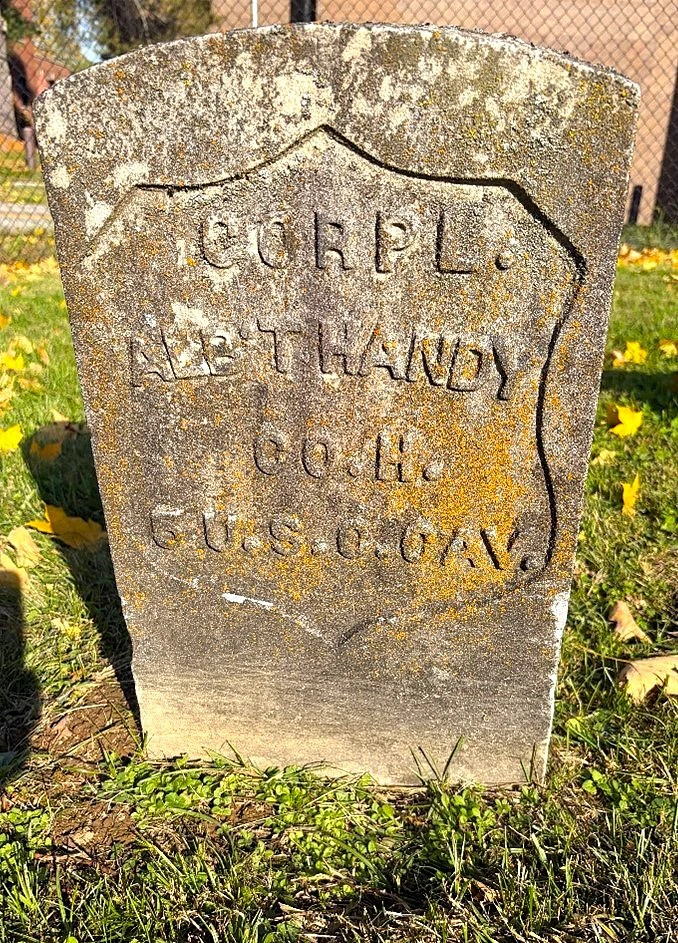
Corporal Albert Handy’s Grave, Company H, 5th USC Cavalry, Green Hill Cemetery, Frankfort, Kentucky. Photograph by author.
We will, of course, never know everything about the men who served in the USCT, or what their experience truly felt like as they sought their freedom through military service. But the USCT muster roll provides us with a solid foundation from which researchers can explore the lives and experiences of these individuals. Such is the importance of digitizing this roll so that far into the future these men who braved and sacrificed so much in pursuit of freedom will not be lost to history. Who knows what other stories live inside the ledger’s pages, just waiting to be told?
Coming next month: Who was the most despised U.S. congressman in 1798? Learn the story of Matthew Lyons in our next post.
Additional References:
“Black Soldiers in the Civil War,” American Battlefield Trust, 7 June 2013, 3 min., 30 sec.
“Colored Troop Regiments from Kentucky,” Notable Kentucky African American Database.
Richard Sears, “John G. Fee, Camp Nelson, and Kentucky Blacks, 1864–1865,” The Register of the Kentucky Historical Society 85, no. 1 (Winter 1987): 29–45.
A Grand Army of Black Men: Letters from African-American Soldiers in the Union Army, 1861– 1865, ed. Edwin S. Redkey (Cambridge University Press, 2010).
John David Smith, Lincoln and the U.S. Colored Troops (Southern Illinois University Press, 2013).
Amy Murrell Taylor, Embattled Freedom: Journeys through the Civil War’s Slave Refugee Camps (University of North Carolina Press, 2020).
NOTES
[1] Elsie Freeman, Wynell Burroughs Schamel, and Jean West, “The Fight for Equal Rights: A Recruiting Poster for Black Soldiers in the Civil War.” Social Education 56, no. 2 (February 1992): 118–20.
[2] Kentucky’s 7th, 8th, and 9th Congressional Districts included the following counties: Woodford, Franklin, Mercer, Boyle, Lincoln, Letcher, Harlan, Knox, Clay, Owsley, Wolfe, Whitley, Laurel, Jackson, Perry, Breathitt, Estill, Madison, Pulaski, Garrard, Rockcastle, Wayne, Mason, Lewis, Greenup, Boyd, Powell, Fleming, Rowan, Carter, Lawrence, Morgan, Johnson, Floyd, Pike, Magoffin, Montgomery, and Bath.
[3] To learn more about the Kentucky Historical Society Volunteer Program, visit https://history.ky.gov/participate/volunteer.
[4] I was able to locate the graves of the following USCT soldiers in Frankfort Cemetery: Andrew Anderson, Company C, 119th USC Inf.; William Bush, Company I, 114th USC Inf.; Moses Carter, Company K, 5th USC Cav.; Charles Clifford, Company K, 5th USC Cav.; John Dunlap, Company A, 116th USC Inf.; George Ellis, Company H, 114th USC Inf.; Robert Greene, Company I, 100th USC Inf.; Albery Handy, Company H, 5th USC Cav.; William Lumix, Company I, 114th USC Inf.; Isaac Myers, Company F, 5th USC Cav.; James Stewart, Company I, 114th USC Inf.
