
"Wrap securely, Address correctly” Innovations of Postal Mail during World War II
How many of us pay a little extra attention to our mailboxes and doorsteps this time of year in anticipation of cards and packages arriving ahead of the holidays?
If you were one of the 16.4 million Americans who served during World War II, that feeling would have been familiar—especially so for those fighting overseas in far-flung places such as Sicily, Burma, Tunisia, Belgium, or the Philippines. To the American serviceman or woman, mail from home was a tiny but powerful reminder of what they were fighting for.
The logistical hurdles facing the U.S. Postal Service and its U.S. military counterparts during the war were considerable as they transported billions of letters and parcels to nearly every corner of the globe. Americans overseas clamored to hear from their loved ones while those at home sought constant reassurances that their relatives in uniform were okay.
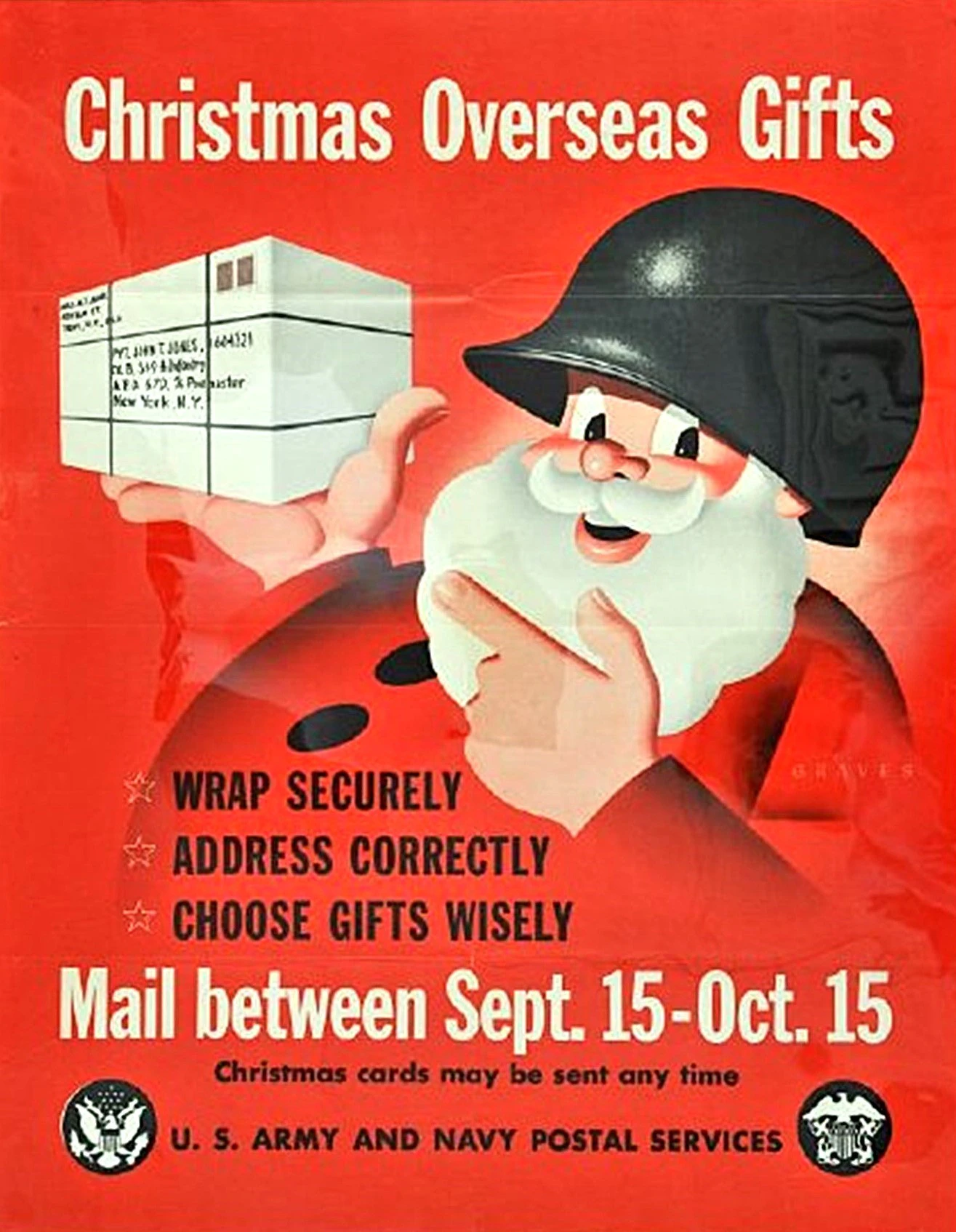
[Ill. 1. World War II Santa Claus Poster, 1945.]
The result was a nonstop torrent of communications that threatened to sap the U.S. military and its allies of precious resources and manpower needed for the fight against the Axis powers.
The Kentucky Historical Society’s (KHS) collections contain several items that illustrate the importance, challenges, and innovations of postal mail during World War II.
Military history enthusiasts and philatelists alike will recall World War II as the age of “V-mail.” Short for “Victory mail,” these letters were photographed and shrunk onto rolls of microfilm that were then shipped to their destinations, enlarged, and duplicated on glossy paper before being delivered to their intended recipients.
According to the Smithsonian National Postal Museum, “V-mail ensured that thousands of tons of shipping space could be reserved for war materials.” Dozens of mail sacks could be condensed into one, which sped up delivery and allowed for the reallocation of personnel and resources to other tasks more directly linked to the war effort.1
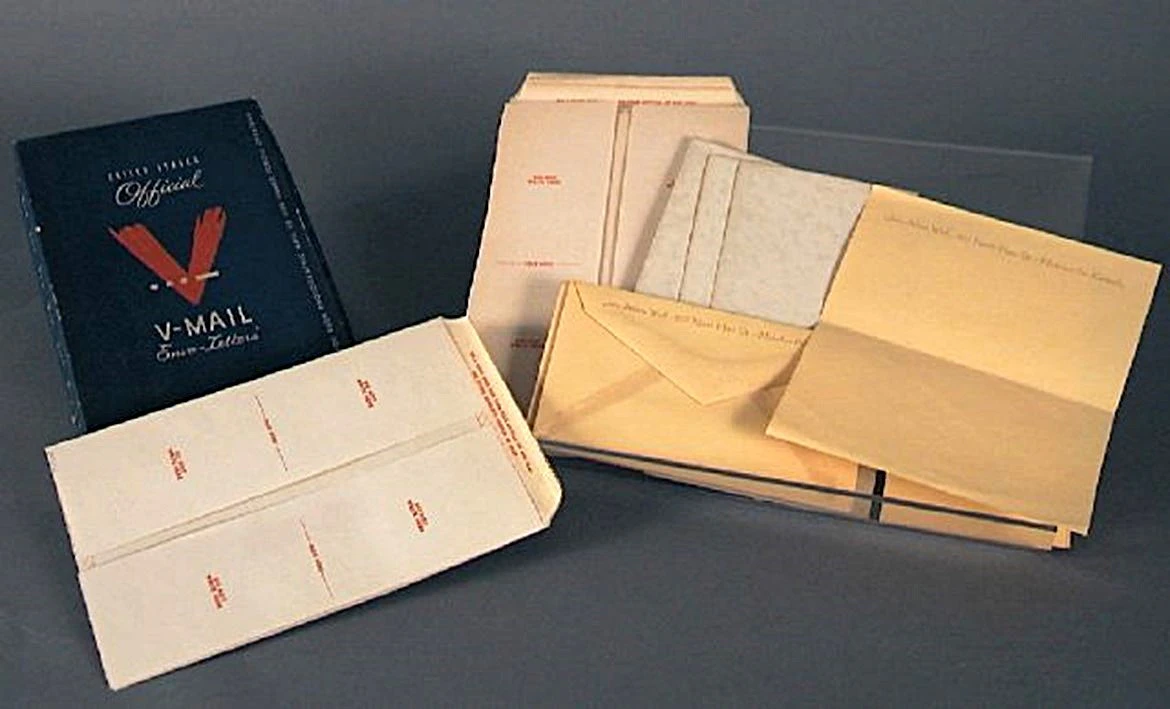
[Ill. 2. V-Mail Stationery and Envelopes, ca. 1942.]
To expedite the microfilming process, V-mail required the letter writer to use special, standardized stationery available at domestic retailers or the closest military post exchange (PX). The Kentucky Historical Society has several V-mail stationery sets among its holdings. When folded according to the instructions, each letter becomes its own envelope, saving resources and accelerating processing. While any ink could be used to scrawl a note, the Parker Pen Company claimed that its micro-film black ink “Quink” provided the “finest reproduction for V-mail” when it came to ease of use for the writer and legibility for the eventual reader.
Government posters encouraging Americans to write to their loved ones abroad using V-mail hung in public spaces across the United States during the War. One such poster, which hung in the public library in Glasgow, Kentucky, encouraged young women to write their boyfriends and husbands far away so that they might “[b]e with him at every mail call.” It assured them that “V-mail is private, reliable, [and] patriotic.”
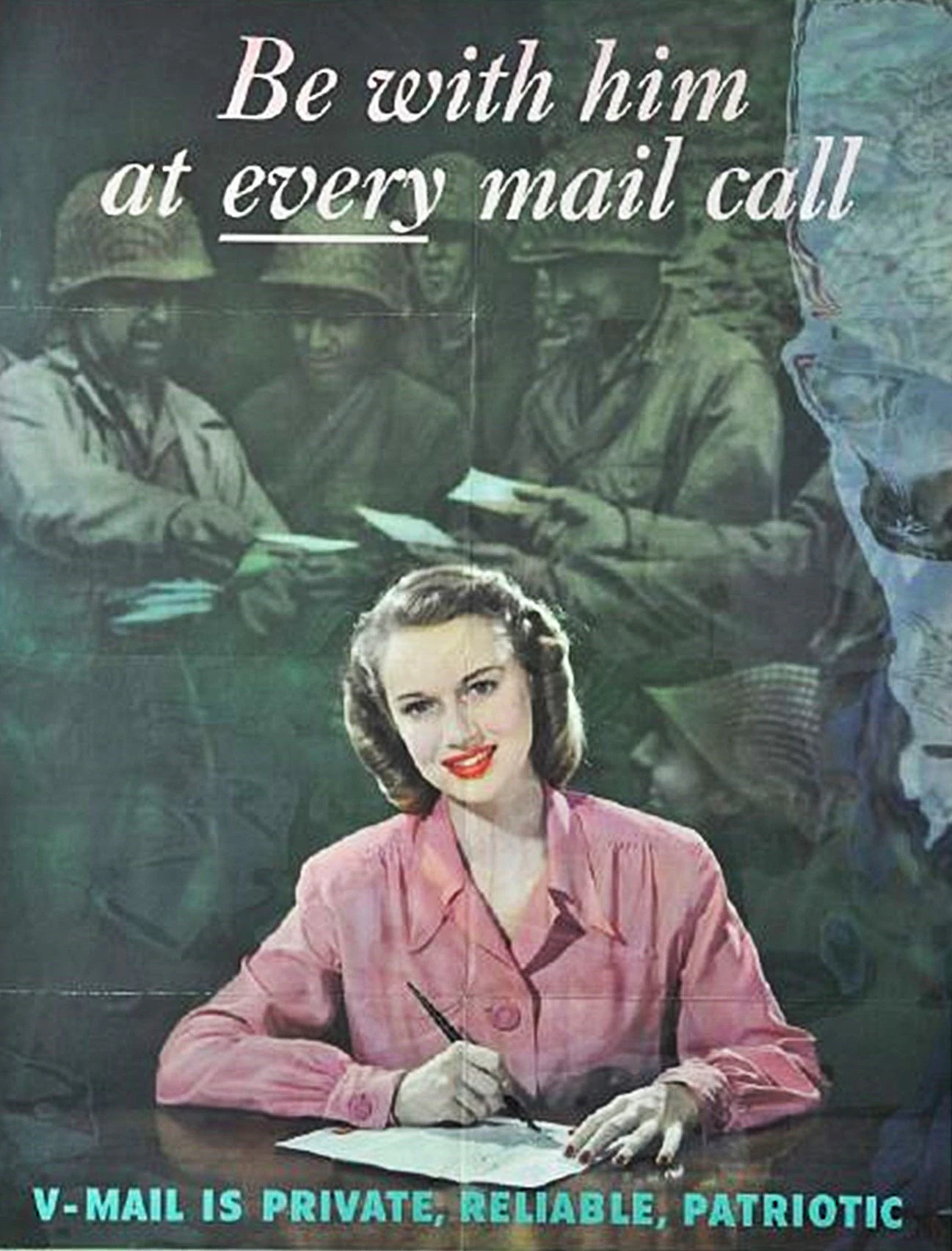
[Ill. 3. “Be with him at every mail call …” Poster, ca. 1943.]
Even so, many writers and their recipients considered microfilmed photographs of original letters to be poor substitutes for something they had held in their own hands, invested time in, perhaps perfumed, and even kissed. (Apparently, lipstick marks led to frequent breakdowns of the microfilm equipment!). 2
Despite V-mail’s lingering presence in our collective memory of World War II, the National Postal Museum reminds us that most Americans still preferred to send letters the old-fashioned way: as regular first-class mail, despite the complications it caused or delays they experienced. For example, in 1944, U.S. Navy personnel received approximately six regular letters on average for every piece of V-mail that arrived. 3
Another poster that once hung in Barren County’s public library testifies to the widespread public sentiment that there’s no substitute for the real thing as far as wartime mail was concerned. The image, emblazoned with holiday red, shows a rotund Santa Claus wearing a combat helmet as he holds a package.
For “Christmas Overseas Gifts,” the poster advised potential senders located stateside to “wrap securely, address correctly, choose gifts wisely.” Most shocking of all, to ensure prompt delivery ahead of the holiday, the poster warned that parcels must be mailed “between Sept. 15–Oct. 15.” Given those dates, one suspects that these posters probably went up in public buildings across the country around Labor Day, cautioning viewers that they should square away their Christmas shopping for distant loved ones before the heat of summer had even abated!
So, keep that in mind the next time you complain that the Christmas shopping season seems to start just a little bit earlier each year, or you find yourself racing to the post office at the last possible moment in December to get a package or card in the mail. History reminds us that things were even more challenging during the Second World War.
Coming next month
Interested in the Civil War in Kentucky? Our next blog post recaps the Kentucky Historical Society’s third annual Civil War History Day, which featured a lecture by Dr. Anne E. Marshall (Mississippi State University) about her new book, Cassius Marcellus Clay: The Life of an Antislavery Slaveholder and the Paradox of American Reform.
Additional Reading and Viewing:
“Communication: Letters & Diaries,” The War, directed by Ken Burns and Lynn Novick, 2007.
Kimberly Guise, “Mail Call: V-mail,” National World War II Museum blog post, December 7, 2019.
Lynn Heidelbaugh, “Victory Mail of World War II: When Sending Microfilmed Letters Contributed to the War Effort,” Pritzker Military Museum & Library webinar, December 19, 2023.
“Soldier’s Last Letter,” hit country music song written by Redd Stewart and Ernest Tubb, performed by Ernest Tubb, 1944.
Smithsonian National Postal Museum, “Military Mail Call.”
Smithsonian National Postal Museum, “Victory Mail.”
1 “V-Mail,” Smithsonian National Postal Museum, https://postalmuseum.si.edu/exhibition/the-art-of-cards-and-letters-military-mail-call/v-mail.
2 “V-Mail’s Limitations,” Smithsonian National Postal Museum, https://postalmuseum.si.edu/exhibition/victory-mail-using-v-mail/v-mails-limitations.
3 “V-Mail,” Smithsonian National Postal Museum.
