
William Goebel: The Man Behind the Statue
At the turn of the twentieth century, political chaos rocked Kentucky. The state gubernatorial election of 1899 was the most contentious contest since the U.S. Civil War. The election pitted William Goebel, a Democrat and president of the state senate, against Republican William Taylor, the sitting attorney general.
Goebel was a controversial candidate. Despite his Progressive policies, Goebel employed shrewd political tactics to accomplish his legislative agenda, which ruffled feathers across the political spectrum. In fact, so controversial was Goebel’s nomination for governor on the Democratic ticket in 1899 that it spurred former Democratic governor, John Young Brown, to run as a third-party candidate.1
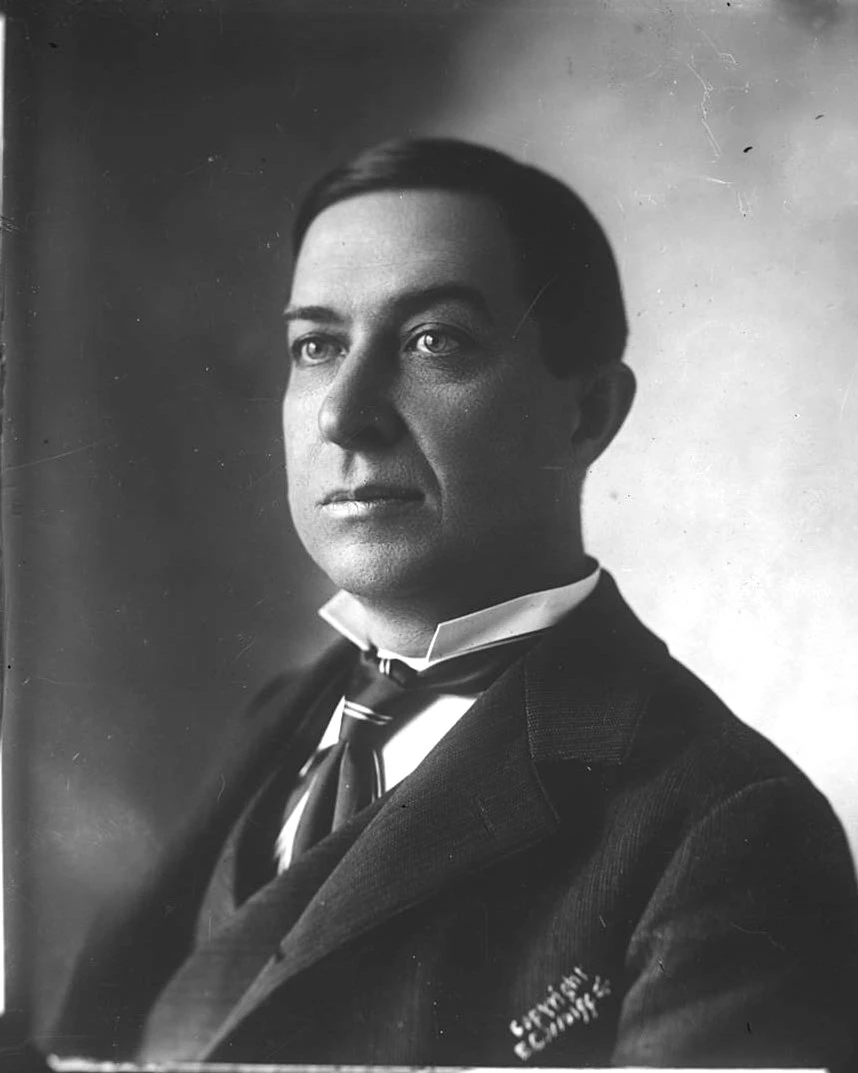
Ill. 1. William Goebel Portrait, ca. 1900, Graphic 2, Box 117, F7, Wolff, Gretter, Cusick and Hill Studios Negatives, Kentucky Historical Society, Frankfort.
William Taylor, on the other hand, was not without controversy either. He was a strong supporter of the railroads, particularly the imposing Louisville and Nashville Railroad (L&N). Goebel and like-minded Democrats ardently opposed railroad Republicans, such as Taylor, whom they publicly denounced, along with their corporate backers, as enemies of the common people.2
After a contentious campaign, Taylor narrowly defeated Goebel by approximately 2,300 votes. Democrats, however, immediately contested the results of the election, claiming fraud and intimidation. Despite their protest, Taylor was inaugurated as governor in December 1899. Although Goebel resumed his position in the state senate, he did not concede the election. When the General Assembly reconvened in January 1900, Democrats filed a notice of contest of the election. The legislature selected eleven representatives to investigate the election results. But before the delegation could issue a verdict tragedy struck.3
On the morning of January 30, 1900, an assassin shot Goebel as he walked up the lawn to the Old State Capitol. The shot struck Goebel on the right side of his chest and pierced his lung before leaving his body. When bystanders reached Goebel, he was bleeding profusely, and it was abundantly clear that the wound was fatal. Doctors rushed Goebel back to his room at the Capital Hotel where they attempted to save his life. Goebel lingered for a few more days before he succumbed to his wound on February 3, 1900, at the age of forty-four. Allegedly, his last words were “Tell my friends to be brave and fearless and loyal to the great common people.”4
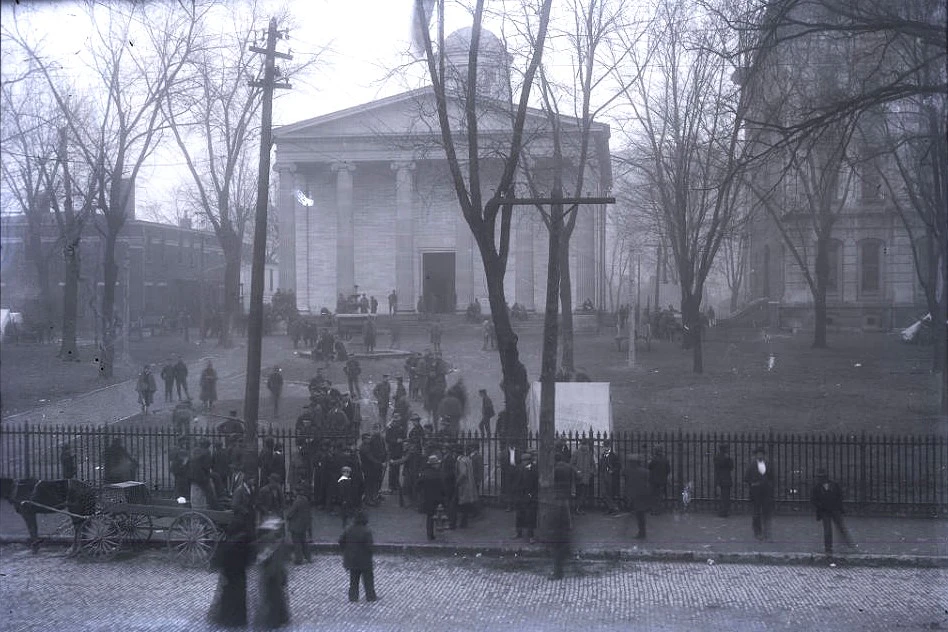
Ill. 2. Old State Capitol, Frankfort, Ky, 1900. This image was taken following the shooting of William Goebel on January 30, 1900. Graphic 2, Box 56, F037, Wolff, Gretter, Cusick and Hill Studios Negatives, Kentucky Historical Society, Frankfort.
In the meantime, William Taylor, the sitting governor, declared a state of insurrection and deployed the militia. Taylor called the General Assembly to convene in London, an instruction that was only followed by Republican representatives. Democratic members of the assembly remained in Frankfort where they attempted to reconvene at the capitol but were barred from doing so by soldiers equipped with a Gatling gun and cannons. Democrats eventually convened at the Capital Hotel where they declared Goebel the victor of the gubernatorial election and swore him into office from his bedroom. This act created two separate governments in Kentucky, one Republican and one Democratic, both of which claimed legitimate power. When news spread of this development, Kentuckians feared the outbreak of another civil war.5
Fortunately, cooler heads prevailed.
Following Goebel’s death, the mantel of governor fell to J. C. W. Beckham, the young but politically well-connected lieutenant governor. In addition to Beckham’s ascension, Democrats and Republicans agreed to recognize Goebel as the legitimate victor in the election. They also offered immunity to anyone involved in the assassination. Taylor, however, refused to concede the election and demanded the courts settle the matter. The Kentucky Court of Appeals ultimately declared Goebel the winner of the election. When Taylor petitioned the U.S. Supreme Court to reconsider the ruling, they refused, solidifying the lower court’s ruling and Beckham’s right to the governor’s office.6
The hunt for Goebel’s assassins was less conclusive. A grand jury issued sixteen indictments to men who were suspected of orchestrating the murder, including William Taylor, who avoided prosecution by fleeing to Indiana. Yet, only three individuals: Caleb Powers, Taylor’s secretary of state; Henry Youtsey, a clerk in the State Auditor’s office; and Jim Howard, whose relationship to the others is unclear, were convicted and given life sentences in connection to the assassination. By 1919, each man had received a pardon.7
In the years following Goebel’s death, Kentucky Democrats transformed him into a martyr. They distributed prints, buttons, and pamphlets depicting his likeness and even erected statues of Goebel. But who was William Goebel really? Was he in fact a champion of the people as some claimed? The nature of his death and the political myth-making that followed has largely shrouded the real man behind the statue that now sits upon the Old State Capitol lawn.
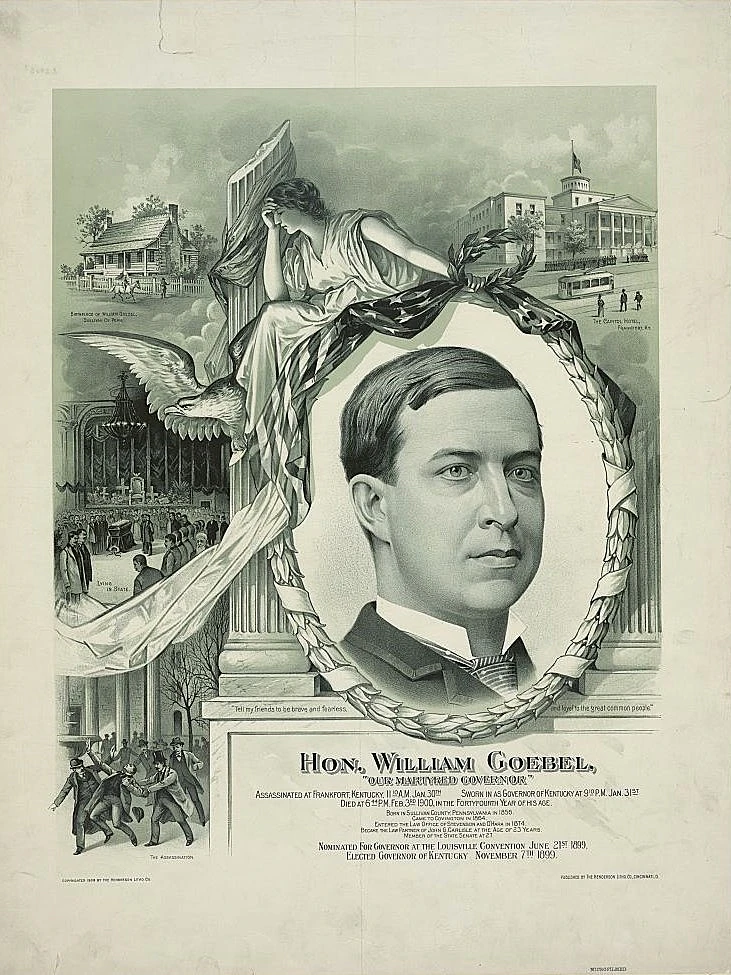
Ill. 3. Print Titled “Hon. William Goebel, ‘Our Martyred Governor.’” Library of Congress Prints and Photographs Division, Washington, D.C.
William Goebel entered Kentucky politics at a moment marked by deep divisions in the commonwealth. State Republicans and Democrats differed greatly on issues regarding Kentucky’s social and economic future. Goebel entered this arena first as an attorney, developing a reputation as a “poor man’s lawyer.” His appeal to everyday Kentuckians helped him win a state senate seat in 1887. Over the next fourteen years, Goebel worked to implement Progressive change, advocating for reforms such as women’s suffrage, protecting and expanding African American civil rights, and improving Kentucky’s education system and transportation infrastructure.8
While successful, Goebel’s political methods were contentious. For instance, in 1895 he championed a controversial election law, the “Goebel Election Law,” which created a state election commission that would decide contested elections and investigate election malfeasance. The law granted the General Assembly, then controlled by Goebel and his allies, the exclusive right to appoint the members of the commission. Goebel’s opponents immediately cried foul, claiming that the law was a power grab and would function as a safety net for Goebel if he decided to run for governor.9
Indeed, Goebel developed a reputation for his pragmatic political approach during his time in the General Assembly, earning him the monikers “King of Kenton” and “Boss Bill.” His tactics, however, were not without impact. Goebel authored legislation that introduced Progressive Era reforms to the commonwealth. Some of his prominent legislative contributions included a corporate franchise tax, school-book legislation, and a bill that regulated the railroad industry in Kentucky.10
While effective, Goebel’s tactics produced intense political rivalries. Perhaps most famous was his feud with John Sanford, an ex-Confederate colonel and Covington banker, who had been financially spurned by Goebel’s efforts to reduce road tolls. Both men lambasted each other in the press over the issue during the spring of 1895. Goebel escalated the feud on April 6, 1895, when he anonymously referred to Sanford in an editorial as “Col. John Gonorrhea Sanford.” In other words, Goebel accused Sanford of infidelity. Sanford’s sense of honor demanded that the slight be rectified with violence.11
On April 11, 1895, Sanford sought his satisfaction. In the early afternoon, as Goebel walked toward the First National Bank in downtown Covington, Sanford approached him and demanded to know if he was responsible for the slanderous article. After Goebel unapologetically affirmed, an enraged Sanford reached for a concealed pistol, drew, and fired a shot at close range, which tore through Goebel’s coat but somehow missed him. In response, Goebel also drew a pistol and fired back. Goebel’s shot struck the colonel squarely in the head, killing him instantly.12
In the days after, Goebel’s political opponents accused him of murder. Goebel steered clear of prosecution though, claiming self-defense. Nonetheless, these moments in Goebel’s life reveal that he was no saint and a product of the often chaotic and sometimes violent world of nineteenth century politics.
Stories such as these are important to tell if we are to truly understand Goebel outside the context of his murder. In effort to present a more wholistic view of Goebel, I developed a walking tour, “The Rise and Fall of Governor Goebel,” which debuted on September 20, 2025. The tour takes participants to different locations in Frankfort, offering insights into Goebel’s days as an attorney, his stint in the Kentucky Senate, and his eventual assassination.
Many of the locations where Goebel worked and visited still exist, although they have changed quite a bit since the nineteenth century. For example, the Capital Hotel played a crucial role in Goebel’s story. The building was the site of his political headquarters but also the place where he was taken after he was shot. Much of the building burned in 1917, but a remnant remains as the Capital City Museum.
Frankfort’s unassuming buildings bore witness to the events of Goebel’s life and in greater part, Kentucky’s history. Creating opportunities for patrons to explore face-to-face the tangible places where William Goebel literally and figuratively fought his battles exposes them to the complexity of his life; the political volatility of Kentucky during this period; and the burgeoning Progressive movement in the state. More importantly, it personalizes history and perhaps allows us to better understand Goebel the man versus Goebel the martyr.
Coming next month:
Did you know that Kentucky did not ratify the 13th, 14th, and 15th Amendments to the U.S. Constitution until 1976? In our next blog, learn why the Reconstruction Amendments remained unratified in the commonwealth for over one hundred years.
Additional References:
Ron Elliott, Assassination at the State House: The Murder of Kentucky Governor William Goebel (Acclaim Press, 2016).
“Milton H. Smith Talks About the Goebel Affair,” ed. Edison H. Thomas, The Register of the Kentucky Historical Society 78, no. 4 (Autumn 1980): 322–42.
Nicholas C. Burckel, “William Goebel and the Campaign for Railroad Regulation in Kentucky, 1888–1900,” The Filson Club Historical Quarterly 48, no. 4 (Jan. 1974): 43–60.
Archival Collection: Goebel Family Papers, 1865–1942, University of Kentucky Special Collections Research Center, Lexington.
Podcast: Jonathon L. Earle, “Murder, Memory, and Martyrdom: The Assassination of Governor William Goebel,”
*The Kentucky Historical Society houses numerous objects and manuscripts in physical and digital forms related to the life and career of William Goebel. Navigate to https://history.ky.gov/explore to discover more.
NOTES
[1] Hambleton Trapp and James C. Klotter, Kentucky: Decades of Discord, 1865–1900 (Kentucky Historical Society, 1977), 428.
[2] Marianne C. Walker, “The Late Governor Goebel: He Fought, Killed, and was Killed,” Humanities 34, no. 4 (July/August 2013), https://www.neh.gov/humanities/2013/julyaugust/feature/the-late-governor-goebel.
[3] Walker, “The Late Governor Goebel.”
[4] Trapp and Klotter, Kentucky: Decades of Discord, 447; “Goebel Shot By Assassins,” The (Louisville, Ky) Courier Journal, 31 January 1900, p. 1, newspapers.com; Charles Henry Niehaus, Governor William Goebel Statue, 1914, Bronze on granite base, 300 West Broadway Street, Frankfort, Kentucky, https://visitfrankfort.com/art/governor-william-goebel-statue/.
[5] Klotter, William Goebel, 103–4.
[6] “Within An Hour After Death New Governor Took Hold,” The (Louisville, Ky) Courier Journal, 4 February 1900, p. 5, newspapers.com; Klotter, William Goebel, 110–14; Trapp and Klotter, Kentucky: Decades of Discord, 450–54.
[7] Klotter, William Goebel, 116–24.
[8] Ibid., 8, 13, 16; Ellen Terrell, “The Four Days Governor,” Library of Congress Blogs, https://blogs.loc.gov/inside_adams/2014/06/the-four-days-governor/.
[9] Klotter, William Goebel, 46
[10] Ibid., 22, 36, 43, 44; Trapp and Klotter, Kentucky: Decades of Discord, 414–15.
[11] Walker, “The Late Governor Goebel.”
[12] “Enmity,” The Cincinnati (Ohio) Enquirer, 12 April 1895, p. 4, newspapers.com; Klotter, William Goebel, 34–36; Trapp and Klotter, Kentucky: Decades of Discord, 434.
