
"Video Invasion": Kentucky's Arcade Boom in the 1980s
On October 26, 1982, a five-member panel met in Louisville, Kentucky, to discuss the results of a two-year psychological study, which investigated how to regulate the growing video-game industry. The study, led by psychologist Dr. David Brooks, a specialist in juvenile crime prevention, found that video game arcades posed little threat of increasing truancy and “undesirable behavior” among America’s youth. In fact, Dr. Brooks, also a panelist at the Louisville meeting, explained that he found little correlation between children who frequented arcades and juvenile crime and drug and alcohol abuse. Yet, Chicago alderman Patrick Huels, another panelist, was unconvinced. He disagreed with Brooks’s findings, arguing that it was not the games themselves that caused issues. Rather, it was the location of the arcades and, in his view, the shady characters these spaces attracted that negatively influenced America’s youth.1
Video game arcades were a popular topic of conversation among Americans in the late 1970s and early 1980s. Indeed, advances in technology and the “video gaming” industry’s rapid expansion brought new and exciting changes to leisure and entertainment spaces across the nation. However, their sudden popularity concerned parents, legislators, and journalists. They associated the industry with crime and corruption of American youth, while business owners, spokesmen for the emerging video game industry, and legislators (again) spoke out against regulation.
Video games existed in the United States prior to the late 1970s. In fact, the original technologies for arcade and computer games were developed in the U.S. Yet, in 1978, Japanese video game developers from the Taito corporation dramatically changed the industry when they released the game Space Invaders (1978). The game, a classic in what would become the “shoot ‘em up” genre, caused a national coin shortage in Japan and sold three-hundred thousand arcade cabinets (sixty thousand in the United States alone).2
Kentucky was not excluded from the new craze. In September 1980, the Lexington Leader proclaimed that “The Video [Game] Attack” had arrived in the city in the form of upwards of fifty Space Invaders machines. The game was so popular that Earl Parker, an arcade manager at Lexington Mall, said one of his two Space Invaders machines alone averaged forty dollars in coins every day.3 In an era where a popular game meant selling fifteen thousand units, Space Invaders was a smashing hit.
Throughout 1981 video game arcades sprung up across Kentucky. From April to September, at least five new arcades opened in Louisville alone. In Owingsville, a town of no more than fifteen hundred residents, a couple sought a permit to open the second video game arcade in the small town. Owensboro boasted of at least thirty businesses with arcade machines present. Likewise, video game arcades became a “local craze” in Liberty, and “clean” or “family” arcades advertised their openings in Greenup, London, and Marion.4
The arrival of new games to the American market also spurred further excitement and intrigue regarding Kentucky’s burgeoning arcade industry. In 1980, another Japanese-developed game, Namco’s Pac-Man (try it out!), took North American markets by storm, selling one-hundred thousand units. As a result, these Japanese exports shifted entertainment and leisure norms across the world. Pac-Man arrived in Lexington “the day after Thanksgiving” in 1980, and a year later there were at least thirteen Pac-Man machines in a single two-block area near the University of Kentucky. The Lexington-Fayette government only licensed 24 arcade cabinets in 1978. Following Pac-Man’s release, this number skyrocketed. In 1981, the city licensed 137 arcade cabinets for operation, which was over 5 times the amount it had in 1978.5

Pac-Man Video Game Cartridge, 1981. Catalog Num.: 2002.20.9, Dan Zwyer Collection, Kentucky Historical Society, Frankfort.
As a product of their popularity, video games and arcades attracted commentary from a wide cross-section of Kentucky society. But not all Kentuckians found video games attractive. Some were concerned about the industry’s impact on the state’s youth. Part of the concern stemmed from the fact that people did not understand video games’ appeal. Were they a “way to cope with peer pressure” and “relieve tension?” Were they as “addictive as gambling”? Would unsupervised children be entering spaces inhabited by “undesirables” who represented “gambling and drug pushing elements.” These were the questions that percolated among those anxious about the video game boom in the Bluegrass State.6
The concern about video game arcades did not simply emerge out of thin air. Rather, the negative reaction was rooted in long-standing assumptions that “amusement arcades,” as they were called prior to the arrival of video games, attracted “sleazy” and “disreputable” individuals. “Coin-op” machines ranging from laundromats to pinball, for example, had long been associated with organized crime.7 Thus, video game arcades’ reputations suffered from decades of built-up stereotypes.
These stereotypes also fed off white Americans’ racial anxieties. Parents feared their inability to control their kids’ associations in these new public and less regulated entertainment arenas. The rise of the War on Drugs in the 1980s exacerbated these anxieties. In response, national arcade owners, attempting to reshape their seedy image, began moving their businesses to suburban malls to create “sanitized” family fun spaces. Such moves reflected a calculated whitening of arcade spaces. Thus, by moving to the suburbs, arcade owners hoped to improve their businesses’ image by eliminating their urban “dirty,” and often racially coded, associations.8
Kentucky’s arcade owners likewise attempted to reform the industry’s image. Charles McLemore, a Paducah arcade owner, insisted that his arcades were “well-lighted and properly supervised.” Tony’s Arcade in Lexington worked with the Young Women’s Christian Association Spouse Abuse Center to sponsor a citywide Pac-Man tournament, donating entry fees to the center to demonstrate the positive social impact of arcades.9
Yet, as more arcades popped up in Kentucky in 1982, accusations that video games were a social blight increased. One columnist in the Lexington Leader described video games as “electronic drugs” that could turn a person into a “full-fledged vidiot” in a single night. Ironically, a different columnist in the same issue of the Leader, capitalized on Pac-Man’s popularity by publishing a full strategy guide on the game. The duality of opinions owed to the broader conflict at play between consumer capitalism and tradition in places such as Lexington.10
Residents in Burlington, Kentucky, believed that arcade owners themselves were liable for the potential damage they caused to youth who frequented their establishments. In June 1982, 221 Burlington residents, led by Janice Wallace, filed a petition in the Boone Fiscal Court to close the Triple Play arcade. Wallace told the court her son had spent fifty dollars there, blaming the management for “allowing him to do so.” One of the arcade’s owners, Kathy Kirby, claimed that the child only spent eight dollars at Triple Play, and that she had honored a request from Wallace to bar her child from the arcade after the incident. Kirby told the court that she did not understand why residents had suddenly turned against the arcade. She instructed her attendants to “keep a sharp eye out for alcohol and drugs” due to previous complaints but “The connotation of game room is such a negative one around here that people automatically get it in their minds that we are just like all the rest.” Despite Kirby’s efforts, the links between arcades and poor morality scuttled promises from businesses.11
Even with the public backlash, video game arcades continued to grow in popularity in Kentucky. In 1982, Lexington licensed 1,548 cabinets in the first three months of the year, over ten times that of the previous full year. In response, Lexington city councilman John Wigginton created what he deemed a “plan to cure Pac-Man fever.” He called upon the city council to investigate regulating and taxing Lexington’s arcades, claiming that “video games are causing a growing problem in that kids seem to prefer the arcades to school.” The council considered several questions about arcades and possible regulatory measures, ranging from age restrictions to regulating arcades’ business hours when schools were in session. In a split decision, the council ultimately ruled against regulation.12

A Marine Spends Time Playing a Video Game on the USS America, 1982. NAID: 6384062, Record Group 330: Records of the Office of the Secretary of Defense, Combined Military Service Digital Photographic Files, U.S. National Archives and Records Administration, Washington, D.C.
For all the debate about arcades, the “invasion” dissipated rather quickly. In 1983, two of Owensboro’s arcades closed in a period of six months. By July, national headlines predicted a 25 to 30 percent downturn nationwide in arcade profits. Owensboro arcade operators blamed the “bad rep” from parents for the decline in the industry. Arcade operators also blamed “manufactures for introducing home video games that competed with commercial games” for the industry’s troubles. The popularity of the former stemmed from the fact that parents could directly supervise the content their children consumed. While the combination of these factors did not help, oversaturation and high overheads created an unsustainable market that primarily caused the decline.13
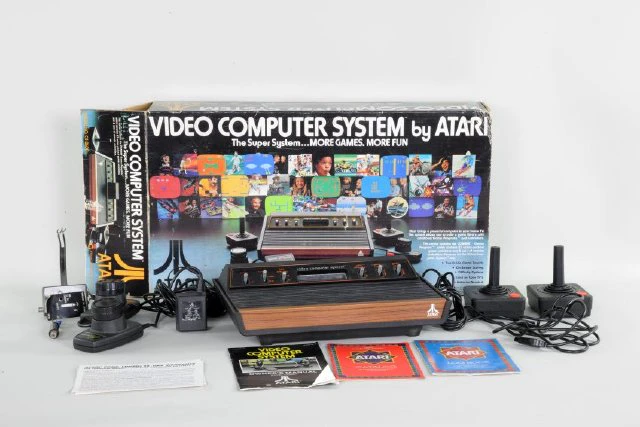
Atari Video Computer System, ca. 1978–1980. Catalog Num.: 2002.20.1, Dan Zwyer Collection, Kentucky Historical Society, Frankfort.
Ultimately, arcades failed to escape decades of association with criminality. The tense climate of the culture wars also increased concerns about youth culture and societal decay, which combined with the financial precariousness of the industry proved insurmountable for video game arcades. The arrival of more powerful home video games consoles, such as “ColecoVision” in 1982 and the revolutionary “Nintendo Entertainment System” in 1985, eased parents’ concerns regarding these issues.14 While Kentucky did not heavily regulate its arcade industry, the state hosted intense debates over their role in society. By 1983 it was “game over” for Kentucky’s arcade craze as it was also in much of the United States.


Coming next month:
KHS's oral historian Michael Kilmore reflects on fifty years of the Kentucky Oral History Commission, the only state commission in the nation committed to statewide oral history documentation through granting programs and outreach.
Additional References:
Steve L. Kent, The Ultimate History of Video Games: From Pong to Pokémon and Beyond (Three Rivers Press, 2001).
Michael Z. Newman, Atari Age: The Emergence of Video Games in America (MIT Press, 2017).
Kyle Riismandel, “Arcade Addicts and Mallrats: Producing and Policing Suburban Public Space in 1980s America,” Environment Space, Place 5, no. 2 (2013): 65–89.
Mia Consalvo, “Convergence and Globalization in the Japanese Videogame Industry,” Cinema Journal 48, no. 3 (Spring 2009): 135–41.
M. J. P. Wolf, The Medium of the Video Game (University of Texas Press, 2001).
NOTES
[1] David Goetz, “Video-game Debate Lights Up Recreation Officials’ Parley,” The (Louisville, Ky) Courier-Journal, 27 October 1982, newspapers.com.
[2] David Reed, “Video Games,” Lexington (Ky) Herald, 9 December 1977, newspapers.com; Jason Whittaker, The Cyberspace Handbook (Taylor & Francis Group, 2003), 130–34; Mark J. P. Wolf, The Medium of the Video Game (University of Texas Press, 2001), 44.
[3] Reed, “Video Games,” Lexington (Ky) Herald, 9 December 1977, newspapers.com; John Woestendiek, “The Video Attack,” Lexington (Ky) Leader, 11 September 1980, newspapers.com.
[4] Kay Stewart, “Video Explosion,” The Courier Journal (Louisville, Ky), 8 September 1981, newspapers.com; “Ray Toy Named Chief of Police,” Bath County News-Outlook (Owingsville, Ky), 9 July 1981, newspapers.com; Smith, “Arcade Invaders,” Messenger-Inquirer (Owensboro, Ky), 25 October 1981, newspapers.com.; Pam Durham, “Electronic Video Games are Becoming Local Craze,” The Casey County News (Liberty, Ky), 10 December 1981, newspapers.com ; Wayne Slaven, “Game room is Really ‘Clean,’” The Crittenden Press (Marion, Ky), 25 November 1981, newspapers.com; “Coming Friday, May 15, 1981: The Family Arcade,” The Sentinel-Echo (London, Ky), 14 May 1981, newspapers.com; “Wizard Arcade Opens,” The Greenup (Ky) News, 3 August 1981, newspapers.com.
[5] Diane Amann, “Video Invasion,” The Lexington Leader, July 20, 1982, newspapers.com.
[6] Stewart, “Video Explosion.”; Clara Germani, “Just How Addictive are Video Games?” The (Frankfort, Ky) State Journal, 24 November 1981, newspapers.com.
[7] Carly A. Kocurek, Coin-Operated Americans: Rebooting Boyhood at the Video Game Arcade (University of Minnesota Press, 2015), 94.
[8] Taylore Nicole Woodhouse, “Feeding the Iron Pimps: The Golden Age of Arcades in Black America,” The International Journal of Computer Game Research 25, no. 3 (2025), https://gamestudies.org/2503/articles/woodhouse; Dana Berthold, “Tidy Whiteness: A Genealogy of Race, Purity, and Hygiene,” Ethics and the Environment 15, no. 1 (2010): 1–26.
[9] Germani, “Just How Addictive are Video Games?”; Dean Cossiboom, “Excitement Abounds in All Quarters,” The Paducah (Ky) Sun, 2 August 1981, newspapers.com; “Benefit Pac-Man Tourney Saturday,” The Lexington (Ky) Leader, 1 December 1981, newspapers.com.
[10] Danny York, “Video Games Invade Laurel County,” The Sentinel-Echo (London, Ky), 4 February 1982, newspapers.com; David Crumm, “The Video Blitz,” The Lexington (KY) Leader, 12 March 1982, newspapers.com; John Rosemond, “Some Call the Craze a Nightmare,” The Lexington (Ky) Leader, 12 March 1982, newspapers.com; Michael Blanchet, “No Quarter: Strategy Helps Beat Pac-Man,” The Lexington (Ky) Leader, 12 March 1982, newspapers.com.
[11] Steve Estes, “Residents Want to Close Triple Play Game Room,” The Boone County Recorder (Burlington, Ky), 17 June 1982, newspapers.com.
[12] Amann, “Video Invasion”; Jim Warren, “Wigginton Has Plan to Cure Pac-Man Fever,” The Lexington (Ky) Herald, 5 May 1982, newspapers.com; Doris Dearen Settles, “Opinions Vary in Lexington,” The Lexington (Ky) Leader, 6 July 1982, newspapers.com; Associated Press, “Games Get Green Light,” The Park City (Ky) Daily News, 26 July 1982, newspapers.com.
[13] Stewart Jennison, “Video Arcade: An Aging Pac-Man Carries a Cane,” Messenger-Inquirer (Owensboro, Ky), 29 May 1983, newspapers.com; Stewart Jennison, “Owensboro Operators Defend Their Establishments,” Messenger-Inquirer (Owensboro, Ky), 29 May 1983, newspapes.com; Associated Press, “Video Arcade Business Boom is Dropping,” Glasgow (Ky) Daily Times, 20 July 1983, newspapers.com.
[14] Warren, “Are Video Arcades Being Zapped?”; Jones Jr., “Games Get No Quarter.;” Kocurek, Coin-Operated Americans, 2–3, 123.