
Hoist the Colors! Raise the Ballots! Political Participation in Henry Clay’s Kentucky
In the presidential election of 1844, Jane Stephens Stout of Frankfort, Kentucky, sewed a flag in support of Democrat James K. Polk of Tennessee.
Polk ran in support of annexing the Republic of Texas against Kentucky’s famed statesman and Whig Henry Clay, who preferred economic improvement over continental expansion. Now in the collection of the Kentucky Historical Society, Stout’s simple white flag, embossed with a red border and cornered with red stars, included a poem directed at supporters of Henry Clay. The flag’s message asked Henry Clay’s supporters, “Whiggies,” to “all come over soon and join our ranks.” The banner’s request was both inviting and mocking. Democrats expected Clay to lose the election thanks to his reputation as a political elite. They frequently compared him to the wily and untrustworthy raccoon. Stout played into these tropes. Her flag warned Whigs that “as sure as the rising moon” they hitched their reputations “on the ghost of a coon.” Given Kentuckians’ consistent support for Henry Clay since 1824, Stout’s banner asked a lot from onlookers in encouraging them to vote against Clay.
Political elections have been a central part of Kentucky’s social and civic life since the 1800s. Artifacts, such as Stout’s banner, illuminate how Kentuckians celebrated election season. They also tell a story about how Kentuckians of the past used election season as a period to engage with one another on the issues that mattered to them most and the candidates they believed aligned with their values and interests.
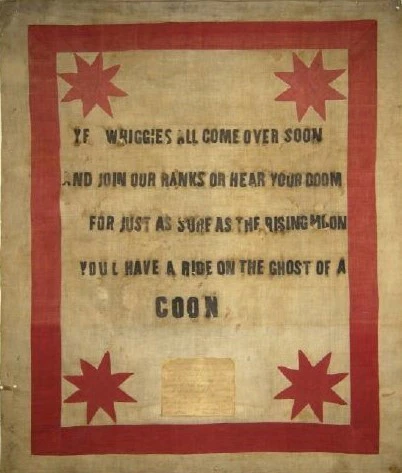
[Ill. 1. James K. Polk Campaign Banner, 1844. Made by Jane Stephens Stout, Catalogue Number: 1962.113, Louisa L. Thomasson Collection, Kentucky Historical Society, Frankfort.]
Twenty-first-century American politics and voting are treated as private matters settled behind the voting booth curtain. In Henry Clay’s Kentucky, it was very different. In the 1800s, there was not one single election day. Instead, there were two: one election day for state offices, such as governor, in August, and another for federal offices, such as President, in November. The community gathered on election day to vote but also to enjoy barbecues, parades, speeches, fireworks, and to reflect on the state of American democracy. Campaigns came with their own songbooks and dance numbers to advertise their candidates and their values.
Jane Stout’s hand-sewn, flour-starched banner was but one relic of these campaigns, used in parades through Frankfort. The newspapers Americans read every day put the presidential candidates they supported right at the top of the sheet, letting everyone know up front where the newspaper stood. Even raising a wooden pole in your yard counted as a political act, with ash trees symbolizing Henry Clay’s Ashland, and hickory representing Andrew Jackson’s nickname, “Old Hickory.”
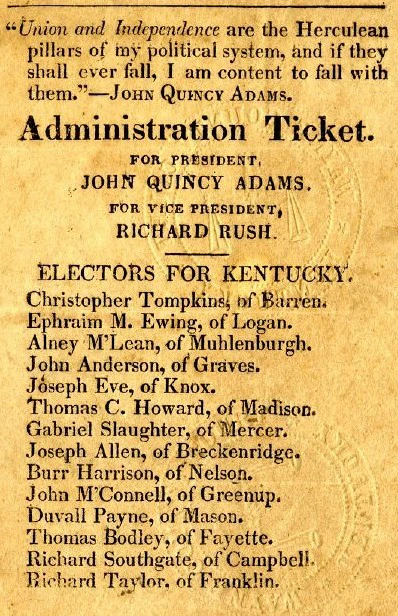
[Ill. 2. John Quincy Adams Handbill for Presidential Election, 1828. Adams lost his reelection bid to Tennessee Democrat Andrew Jackson via the “corrupt bargain.” Catalogue Number: 2000.57, Loralee S. Kukoda Collection, Kentucky Historical Society, Frankfort.]
Whether one could vote or not, they were present and active in the political process.[i] Even if you could not vote, it was clear to most where community members fell along the political spectrum.
White men who could vote in the 1800s were making a public act. Agents from their respective political parties handed out pre-printed tickets for voters to take. Voters grabbed their ticket, announced their name to a judge and supervisor of elections, and dropped the ticket into the designated box, all in open view.[ii] Voters also had to say out loud who they were voting for, a feature Kentucky shared with only a handful of other states. Women, such as Jane Stephens Stout, could not vote. Her daughter, during their lifetime, could not vote either. Yet, before the 19th Amendment’s passage in 1920, women continued to have a presence on the campaign trail. They sewed banners and hosted dinners for their political party’s candidates. Even children got into arguments over politics. For example, a young Whig, Mary Todd, later First Lady Mary Todd Lincoln, once had such an intense political argument with a friend who supported the Democratic Party that “ended in estrangement lasting through many years.”[iii]
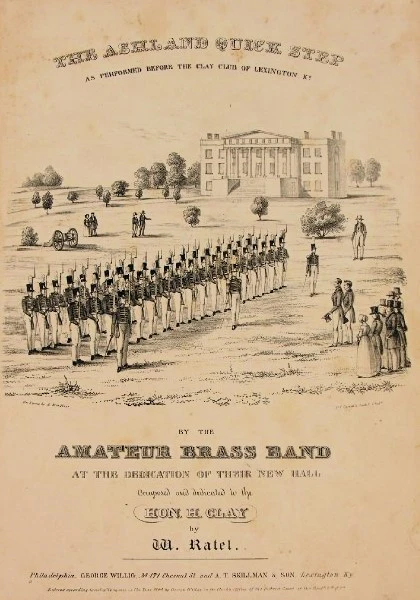
[Ill. 3. Sheet Music, “Ashland Quick Step,” 1844. Composed by W. Ratel and published by George Willig, A. T. Skillman & Son, Lexington, Ky, 1844. Catalogue Number: 2004.41.102, Martin F. Schmidt Collection, Kentucky Historical Society, Frankfort.]
While defending one’s political allegiance could stir confrontation, changing one’s loyalties could as well. Stout’s banner encouraged Kentuckians to publicly turn against Clay. Party affiliations signaled more than who one voted for. It also denoted their social networks, who their friends and family were, and even where they went to church.
We do not know exactly how many Whigs voted against Henry Clay for the Democrat James K. Polk in 1844, but we know many did. In the previous election, the Whig presidential candidate won 64 percent of the vote against the Democrats’ 36 percent. This margin fell in 1844 with Clay getting 54 percent against Polk’s 46 percent.[iv] The former Kentucky congressman Thomas Chilton was one such individual who flipped his loyalties, proudly giving speeches in favor of Clay in April 1844, only to be listed as a Polk supporter that following July.[v] Whatever the reasons for the change, Kentuckians who switched parties had to be firm in their beliefs.
For example, Jane Stout’s flag was not only announcing her own firmly held beliefs in support of James K. Polk and continental expansion, but she was also asking her neighbors to drop their own allegiances come election time. That was quite a big ask. People faced ridicule and even physical violence for being on the wrong side of an issue.
To be politically active in Henry Clay’s Kentucky was an act of bravery. Kentuckians, such as Stout, exemplified the outspokenness Americans felt while participating in their democracy. She was on the wrong side of the partisan divide as a Democrat in a Whig state. Yet, she took time, energy, and effort to produce a piece of campaign material for her preferred candidate and used the platform of a banner to make her views known to her community. Thus, being an active citizen in the nineteenth century required a great deal of conviction.
Coming next month:
What does the digital age offer historians and archivists alike? Read our next blog to learn how digital archivist Alyssa Ollier is breathing new life into some of KHS’s most treasured items.
Suggested References:
“Henry Clay Political Banner,” Kentucky History Treasures, interview by Doug High, featuring Dr. Amanda Higgins, aired 11 August 2021 on WHAS 11 Louisville, posted 22 November 2021, YouTube, 2 min., 40 sec.
2018.
Mark R. Cheathem, The Coming of Democracy: Presidential Campaigning in the Age of Jackson (Johns Hopkins University Press, 2018).
——. Who Is James K. Polk: The Presidential Election of 1844 (University Press of Kansas, 2023).
James C. Klotter, Henry Clay: The Man Who Would Be President. Oxford University Press, 2018).
[i] In the nineteenth century, qualification for voting was laxer than in the present. While women and African Americans were rejected from voting outright, all a prospective white male voter needed to do was affirm an oath to a judge that they were legally qualified to vote. By the 1840s, most property qualifications had been eliminated or decreased enough for most white men to vote.
[ii] See Richard Bensel, The American Ballot Box in the Mid-nineteenth Century (Cambridge University Press, 2004).
[iii] Katherine Helm, The True Story of Mary, Wife of Lincoln, By Her Niece (Harper & Brothers, 1928), 43.
[iv] See David Leip, David Leip’s Atlas of U. S. Presidential Elections, http://uselectionatlast.org.
[v] Untitled, Independent Monitor (Tuscaloosa, Ala.), 17 April 1844, p. 3, newspapers.com; “Change! Change!!” Montgomery (Ala.) Advertiser, reprinted in Semi-Weekly Mississippi Free Trader (Natchez, Miss.), 17 July 1844, p. 2, newspapers.com; “Great changes to the democracy,” Southern Reformer (Jackson, Miss.), 10 August 1844, p.3, newspapers.com.
