
“From the Mouth of a Volcano”: James A. Garfield and the Battle of Middle Creek
Netflix’s docudrama, Death by Lightning (2025), explores the meteoric rise of James A. Garfield (Michael Shannon) from Ohio congressman to the twentieth president of the United States. But before he was “The Man from Ohio,” who stunned the country in the Presidential Election of 1880, Garfield made his name in Kentucky.
Based on Candice Millard’s book Destiny of the Republic (2011), the series portrays Garfield’s path to the White House, including his rousing speech at the Republican National Convention in Chicago in 1880; his brief tenure as president and efforts to dismantle the New York political machine led by “Stalwart” senator Roscoe Conkling (Shea Whigman); and Charles J. Guiteau’s (Matthew Macfadyen) assassination of Garfield a mere 199 days into his presidency.
Yet, the series, given its focus, offers little insight into Garfield’s life and political career prior to the Chicago convention.
The reality is that Garfield was a seasoned politician by the time he ran for president. In 1862 he was elected to Congress as a representative from Ohio’s Nineteenth Congressional District. He held this seat for nearly two decades. On the cusp of his presidential nomination, Garfield was elected to the U.S. Senate with the help of John Sherman—Gen. William T. Sherman’s younger brother whom Garfield initially supported for president in 1880. In somewhat of a consolation prize, the Ohio state legislature elected the younger Sherman to fill Garfield’s senate seat when he assumed the presidency.
Before he was a politician, Garfield demonstrated his capacity for leadership on the battlefield during the U.S. Civil War. A staunch abolitionist, Garfield enlisted in the Federal Army after the bombardment of Fort Sumter in spring 1861. He received a commission as a colonel and was given command of the 42nd Ohio Infantry.
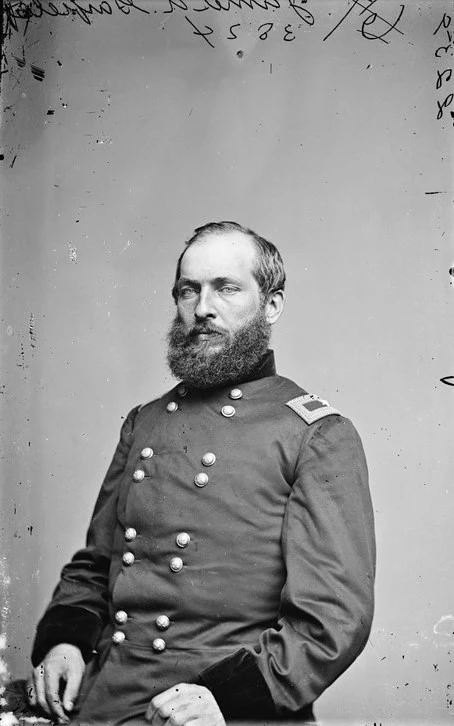
Gen. James Garfield, U.S.A., ca. 1862–1863. Portrait by Matthew Brady. Call Num.: LC-BH82- 3824 B, Brady-Handy Photograph Collection, Library of Congress Prints and Photograph Division, Washington, D.C.
In late 1861, Gen. Don Carlos Buell dispatched Garfield with 1,500 troops from the 18th Army Brigade to Kentucky’s Big Sandy River Valley. Buell tasked Garfield with expelling Humphrey Marshall’s 2,000 Confederates from the valley and ending the Confederacy’s grip on eastern Kentucky.
Garfield and his men arrived in Paintsville, Kentucky, on January 7, 1862, learning that Marshall had withdrawn his men to Middle Creek just outside of Prestonsburg. On January 9, Garfield’s troops entered the city and prepared to move on Marshall’s position the next day.
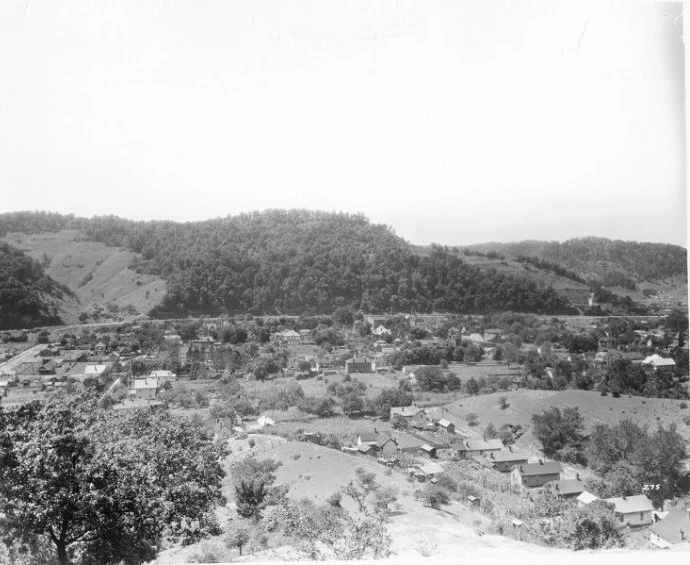
Prestonsburg, Kentucky, ca. 1861–1865. Courtesy of the Kentucky Historical Society.
As Garfield’s Federals entered the mouth of the creek in the early morning hours of January 10, they were met with intense resistance from Confederates who had entrenched themselves in the surrounding hills and ridges. Although both sides produced only ninety-two casualties (twenty-seven Federals, sixty-five Confederates) during the fighting, Garfield recalled that it was fierce and slow-paced. In his after-action report, Garfield remarked that “Inch by inch the enemy, with more than three times our number, were driven up the steep ridges nearest the creek.”1
Marshall’s men also blasted Garfield’s troops with exploding shells from a six- and twelve-pounder cannon. He later wrote to his wife, Lucretia, describing the intensity of the battle: “The agony of the moment was terrible; the whole hill was enshrouded in such a volume of smoke as rolls from the mouth of a volcano, thousands of gun flashes leaped like lightening from the cloud. Every minute the fight grew hotter.”2
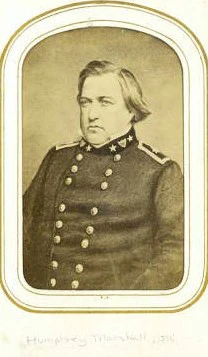
Confederate General Humphrey Marshall, ca. 1861–1865. Courtesy of the Kentucky Historical Society.
By 5 p.m. Federal reinforcements arrived from Paintsville and Garfield finally broke Marshall’s line with a flanking maneuver orchestrated by the 14th and 22nd Kentucky Infantry regiments, along with Garfield’s Ohioans. Dwindling supplies also forced Marshall to retreat from the field lest he risked the complete destruction of his command.
In defeating Marshall, Garfield effectively liberated eastern Kentucky from Confederate control, which allowed the Federal Army to launch an invasion of Tennessee.
Word of Garfield’s victory at Middle Creek spread quickly. James B. Fry, chief of staff for Gen. Don Carlos Buell, complimented Garfield soon after the battle, writing that his conduct “called into action the highest qualities of a soldier—perseverance and courage.”3
In the following weeks and months, newspapers in Kentucky and across the North praised Garfield’s victory, thrusting him into the national spotlight. For instance, the New York Times updated the American public nine days after the battle on what it branded as Garfield’s “bold dash” at Middle Creek. The correspondent wrote that “It is now a known fact that Col. Garfield whipped ‘Falstaff’ Marshall on the 7th, drove in his pickets on the 9th, completely routed his 2,500 men on the 10th, and recovered Prestonsburg on the 11th.” The author concluded that Garfield’s actions, while perhaps rash, were “brilliantly successful.” The Louisville Courier also complimented Garfield, publishing on February 1 that “The recent brilliant success of Col. Garfield in Eastern Kentucky are the subject of much comment in the Eastern papers, and accounts of his life are abundant.”4
Later that month, Garfield was promoted to brigadier general for his actions at Middle Creek.
Garfield did not have to wait long to see his military triumphs translate into political success. Ten months after his victory at Middle Creek, Garfield won his first term in the U.S. House of Representatives despite refusing to campaign for the seat. Upon his election, the Washington Chronicle ran a column titled “A True Soldier,” in which the author profiled Garfield’s life and praised him for his “brilliant movement” at Middle Creek. Given his battlefield success, the author was confident that if Garfield did in fact take his seat in Congress, he would no doubt “make his mark in that body.”5
Garfield would not take his seat in Congress until a full year later when President Lincoln ordered him to do so because of Republicans’ thin majority in the House of Representatives. His delay stemmed from his reluctance to leave his men and the war before it was finished.6
Before his war ended, Garfield saw additional combat at the Battles of Shiloh and Chickamauga. However, it was Middle Creek, the only battle Garfield personally commanded, that was referenced consistently throughout his political career as an indication of his fitness for leadership.
Almost twenty years after the battle, amid a presidential election against Democratic candidate Winfield Scott Hancock (another Civil War general), pro-Republican newspapers pointed to Garfield’s actions at Middle Creek as evidence that he was the best man to lead the country.
On August 4, 1880, less than two months before the election, the Chicago Tribune ran an article titled “Garfield. His Military Career–How He Cleaned Out Humphrey Marshall.” The correspondent wrote that Garfield’s victory at Middle Creek demonstrated his capacity for the presidency, because “the true trial of power comes when a man feels that he is all alone, and is held responsible for defeat or victory.” In comparison the author included a list of Hancock’s wartime accomplishments, which consisted of empty, feint lines. remarking that, “It is a record of which no man fit for the office of president can be proud.”7 In actuality, Hancock was a decorated Civil War veteran and one of the many heroes at the Battle of Gettysburg in 1863.
Garfield’s military record during the Civil War was not the only thing that garnered him enough votes in 1880 to win the presidency. He was a well-seasoned politician and impressive orator. Yet, his courage and bravery at the Battle of Middle Creek highlighted to the American voter his sacrifice and dedication to the nation. For this alone, Garfield, considered one of the “forgotten presidents,” should be remembered.
Coming next month:
In our next blog, “Video Invasion,” read about the controversy surrounding video game arcades in Kentucky during the Cold War.
Additional References:
“Committed to the Cause,” PBS: American Experience, 2 min., 58 sec.
C. W. Goodyear, President Garfield: From Radical to Unifier (Simon & Schuster, 2023).
Daniel J. Vermilya, James Garfield & the Civil War (History Press, 2015).
Benjamin T. Arrington, The Last Lincoln Republican: The Presidential Election of 1880 (University Press of Kansas, 2020).
NOTES
[1] Col. J. A. Garfield to Capt. J. B. Fry, 14 January 1862, Camp Buell, Paintsville, Ky., U.S. War Department, The War of the Rebellion: A Compilation of the Official Records of the Union and Confederate Armies, Ser. 1, Vol. 7 (Government Printing Office, 1882), 30. Garfield’s report provides a detailed description of the battle.
[2] The Wild Life of the Army: Civil War Letters of James A. Garfield, ed. Frederick D. Williams (Michigan State University Press, 1964), 54–61.
[3] Capt. J. B. Fry to Col. James A. Garfield, 24 January 1862, Paintsville, Ky., U.S. War Department, The War of the Rebellion: A Compilation of the Official Records of the Union and Confederate Armies, Ser. 1, Vol. 7 (Government Printing Office, 1882), 23–24.
[4] “Movements in the West: The War in Kentucky,” New York Times, 19 January 1862, 2, ProQuest.com; “Col. James A. Garfield,” Courier-Journal (Louisville, Ky.), 1 February 1862, 4, newspapers.com; Untitled, Courier-Journal (Louisville, Ky.), 27 February 1862, 2, Newspapers.com.
[5] Candice Millard, Destiny of the Republic: A Tale of Madness, Medicine, and the Murder of a President (Anchor Books, 2011), 30; “A True Soldier,” Washington (D.C.) Chronicle, 5 December 1862, 1, Newspapers.com.
[6] Millard, Destiny of the Republic, 30.
[7] “Garfield. His Military Career—How He Cleaned Out Humphrey,” Chicago (Ill.) Tribune, 4 August 1880, 3, newspapers.com.