
A Querulous Yankee in a Kentucky Graveyard
Kentucky state historical marker 130, located in Lyon County’s Eddyville Cemetery, denotes the final resting place of adopted Kentuckian Matthew Lyon. Today, Lyon remains mostly unknown to modern Americans, but he was perhaps one of the more noteworthy political figures of his time. For example, students of U.S. history might recognize the famous political cartoon depicting his brawl in 1798 with fellow congressman Roger Griswold.
There is more to Lyon than his political feuds. This little-remembered soldier and politician lived a life of adventure, trekking everywhere from Ireland to Arkansas. More importantly though, his story represents the ideals, contradictions, and baggage that Americans carried with them as the young nation expanded in the decades after the American Revolution.
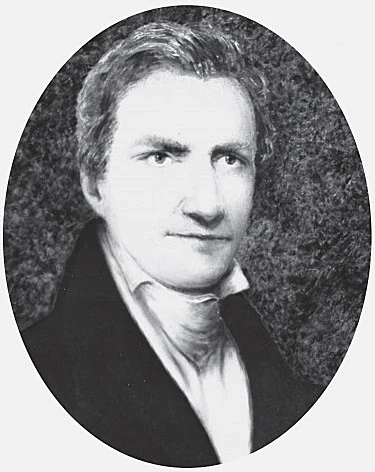
Matthew Lyon Portrait, ca. 1945. This portrait was created at the request of Zenas H. Ellis and based on an original Vermont State House portrait of Lyon. Public Domain.
When the fifty-year-old Matthew Lyon reached Kentucky in 1800, he brought with him a lifetime of rebellion.
In 1764, Lyon, a native of Ireland, arrived in New England via an indentured servitude agreement. In the eighteenth century, it was common for white Europeans, especially lower-class individuals, to finance their relocation to the New World by indenturing their labor for a set period. When the American Revolution erupted, Lyon stood against the British Crown, picking fights with his patron, and ultimately joining Vermont’s famous “Green Mountain Boys.” Perhaps the pinnacle of his war experience was his participation alongside Ethan Allen and Benedict Arnold in the capture of Fort Ticonderoga in May 1775.1
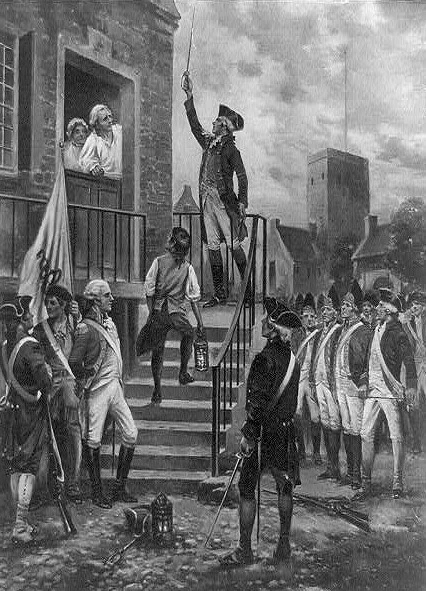
Ethan Allen At Ticonderoga, ca. 1910. Print by Percy Moran, Library of Congress Prints and Photograph Division, Washington, D.C.
His career in Congress, however, earned him the infamy that would follow him for the rest of his life. Representing the state of Vermont, Lyon’s combative personality attracted few friends. “Put simply,” one researcher bluntly described him, “Matthew Lyon couldn’t keep his mouth shut.”
It was not just his tendency to speak his mind that earned Lyon a bad reputation among his congressional peers. For instance, on January 30, 1798, Lyon reportedly spat on Connecticut congressman Roger Griswold after he told Lyon that “If you go into Connecticut, you had better wear your wooden sword.” The cloaked comment essentially alleged that Lyon was a coward and had conducted himself as such during the Revolution. Another person would have ignored the slight, but the Vermonter could not. A critic described Lyon’s rebuttal as an act “so vile, so base, so abominable, so worse than brutal, that our language can not [sic] aptly describe it.” Two weeks later, on February 15, Griswold returned the favor, physically assaulting Lyon on the floor of the House of Representatives with a recently purchased walking stick. To defend himself, Lyon improvised a weapon out of a pair of fire tongs.2
Lyon’s attitude not only got him in trouble with his colleagues, but also with the President of the United States. In June 1798, he attacked John Adams in the press for his “ridiculous pomp, idle parade, and selfish avarice.” Thanks to boiling tensions between the United States and France in the late 1790s, Congress passed the Sedition Act, which criminalized any written speech, defaming the president “or to bring them . . . into contempt or disrepute.”3 As a result, authorities promptly arrested, tried, and convicted Matthew Lyon of sedition against the government that October.
Reactions to Lyon’s imprisonment paralleled the sharply divided political climate of the era. Thomas Jefferson described the Vermonter’s crime as “only general censures of the proceedings of Congress & of the President,” while John Adams’s wife, Abigail, and nephew described Lyon as “the beastly transported Lyon” who should have been “hung and quartered.”4
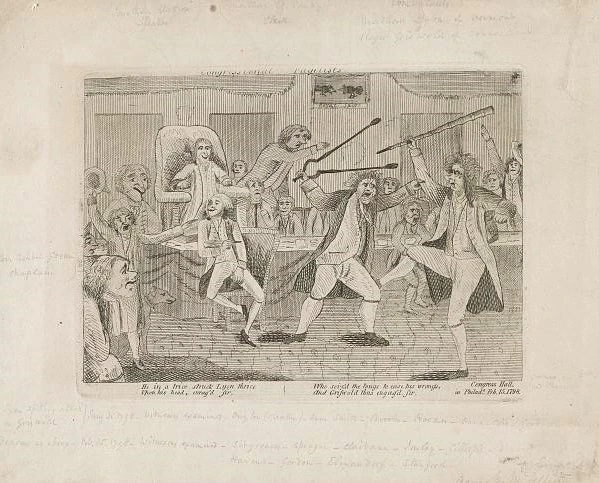
Congressional Pugilists, ca. 1798, Philadelphia, Penn. Political cartoon portraying fight on floor of Congress between Vermont representative Matthew Lyon and Roger Griswold of Connecticut. Library of Congress Prints and Photographs Division, Washington, D.C.
Upon his release months later, the New Englander decided it was time to leave the north and traveled out west. Lyon, lessons unlearned, included the outgoing president John Adams in his farewell taunts. He announced in a March 1801 letter to Adams that he “had fixed [him]self” in Kentucky “an asylum from the persecutions of a party the most base, cruel, assuming, and faithless, that ever disgraced the Councils of any nation.”5
Kentucky’s own revolutionary and rebellious nature perhaps appealed to the recently freed congressman. For one, Kentucky’s legislature countered the federal Alien and Sedition Acts with resolutions of their own. Ghostwritten by Thomas Jefferson, the resolutions claimed that the acts were unconstitutional and “is not law, but is altogether void and of no effect.”6
Once he arrived in Kentucky, Lyon quickly settled into the infant commonwealth’s life. Kentuckians at first were fond of their new resident. By 1803, Lyon had won election to the U. S. House of Representatives, yet again, this time representing Kentucky’s 1st Congressional District.
Another foreign conflict, however, brought out Lyon’s controversial tendencies. Instead of France, this time the United States was once again at odds with Great Britain. In the first decade of the 1800s, presidents Thomas Jefferson and James Madison attempted economic pressure to calm tensions and avoid conflict with the mother country. Jefferson’s trade embargo proved most controversial because in addition to blocking trade with Great Britain it blocked trade with the rest of the world. Jefferson remained popular in Kentucky, but outside the state Federalists and New England’s merchants criticized the embargo as overreaching and disastrous to the nation’s trade.
Lyon spoke out against Jefferson’s and Madison’s economic policy. “I recollect well, very well, the indignation I felt at the conduct of those who were in 1797 hurrying us into an unnecessary war,” the Kentucky congressman wrote in 1810. He opposed the embargo, and the military buildup for war with Great Britain, just as he had criticized war with France. “The same principles govern me now,” Lyon added, as had motivated him in the 1790s.7
Unfortunately for Lyon, Kentucky was not New England. His words fared poorly in the state as popular “War Hawks,” such as Henry Clay and Richard Mentor Johnson, encouraged the national administration towards conflict with England. Unlike in Vermont, Lyon’s constituents did not come to his rescue. He overwhelmingly lost his re-election bid in 1810 by a margin of 3,100 votes. Lyon received just shy of 40 percent of the electorate.8 Lyon never held elected office again, though not for lack of trying. His cantankerous nature cost him too many allies and supporters to keep him afloat politically and financially.
By 1820, Pres. James Monroe appointed the seventy-year-old Lyon as U.S. Factor in the Arkansas Territory, tasked with trading and supplying the Cherokee and Osage Nations with provisions following their removal from the southeast. For the third time in his life, Lyon moved west to escape the challenges of the east.9
His time in Arkansas proved short. On August 1, 1822, death silenced the man willing to risk losing elections, imprisonment, and even violence for his views. Ten years after his death, Lyon made one last trip as his body returned to Kentucky where it was buried in the Eddyville Cemetery.
Matthew Lyon’s eccentric and turbulent life might seem wildly unique, and in many ways, it was. However, Lyon’s tenacity in defending free speech and freedom of thought represented values that many in the Founding Generation considered worthy enough to risk imprisonment for. His foibles were also common in the generation that produced Thomas Jefferson and Alexander Hamilton who exhibited at times the same ego and stubbornness. Just like his more famous counterparts, Matthew Lyon joined post-Revolutionary Americans in their bickering as they attempted to shape how the burgeoning American republic would look.
As we move to commemorate the 250th Anniversary of American Independence, let us recall that the names of the heroes we will hear this year were as human as you or I.
Coming next month:
How did a unique desk design transform education for Kentucky children in the early twentieth century? Learn the story behind KHS’s Chautauqua desk in our next post.
Additional References:
Austin Aleine, Matthew Lyon: “New Man” of the Democratic Revolution, 1749–1822 (Pennsylvania State University Press, 1981).
Charles Slack, Liberty’s First Crisis: Adams, Jefferson, and the Misfits Who Saved Free Speech. (Grove Press, 2015).
Brian T. Neff, “Fracas in Congress: The Battle of Honor Between Matthew Lyon and Roger Griswold.” Essays in History 41, no. 1 (1999): 1–23.
Tom W. Campbell, Two Fighters and Two Fines: Sketches of the Lives of Matthew Lyon and Andrew Jackson (Pioneer Publishing Company, 1941).
Robert P. Williams, By the Bulls that Redamed Me; The Odyssey of Matthew Lyon (Exposition, 1972).
NOTES
- Charles Slack, Liberty’s First Crisis: Adams, Jefferson, and the Misfits Who Saved Free Speech, (Grove Press, 2015), 8–9; Austin Aleine, Matthew Lyon: “New Man” of the Democratic Revolution, 1749–1822 (Pennsylvania State University Press, 1981), 15–16.
- Slack, Liberty’s First Crisis, 6; “For the Gazette of the United States. On Mr. Lyon’s Case,” The North American (Philadelphia, Penn.), 8 February 1798, p. 3, Newspapers.com; Austin Aleine, Matthew Lyon: “New Man” of the Democratic Revolution, 95–100.
- “Trial of Matthew Lyon, For Sedition,” Vergennes Gazette and Vermont and New-York Advertiser (Vergennes, Vt.), 11 October 1798, p. 3, Newspapers.com; An Act in addition to the act, entitled “An Act for the Punishment of Certain Crimes Against the United States,” 1 Stat. 596 (1798). https://www.govinfo.gov/content/pkg/STATUTE-1/pdf/STATUTE-1-Pg596-2.pdf#page=1.
- “Thomas Jefferson to James Madison, 3 November 1798,” Founders Online, National Archives, https://founders.archives.gov/documents/Madison/01-17-02-0119; “Abigail Adams to Mary Smith Cranch, 15 February 1798,” Founders Online, National Archives, https://founders.archives.gov/documents/Adams/04-12-02-0216; “William Smith Shaw to Abigail Adams, 30 December 1798,” Founders Online, National Archives, https://founders.archives.gov/documents/Adams/04-13-02-0164.
- “To John Adams from Matthew Lyon, 4 March 1801,” Founders Online, National Archives, https://founders.archives.gov/documents/Adams/99-02-02-4887.
- “III. Resolutions Adopted by the Kentucky General Assembly, 10 November 1798,” Founders Online, National Archives, https://founders.archives.gov/documents/Jefferson/01-30-02-0370-0004.
- Matthew Lyon to Elias Curtis, 15 March 1810, in Farmer’s Friend (Russellville, Ky.), 25 May 1810, p. 1; Austin Aleine, Matthew Lyon: “New Man” of the Democratic Revolution, 145–47.
- Untitled, National Intelligencer (Washington, D.C.), 12 September 1810, p. 3; “12th Congress: Kentucky 1810,” Mapping Early American Elections, https://earlyamericanelections.org/maps/meae.congressional.congress12.ky.county.html.
- George L. Montagno, “Matthew Lyon’s Last Frontier,” Arkansas Historical Quarterly 16, no. 1 (Spring, 1957): 46–47.