
History Mystery: 1790 Unknown Language
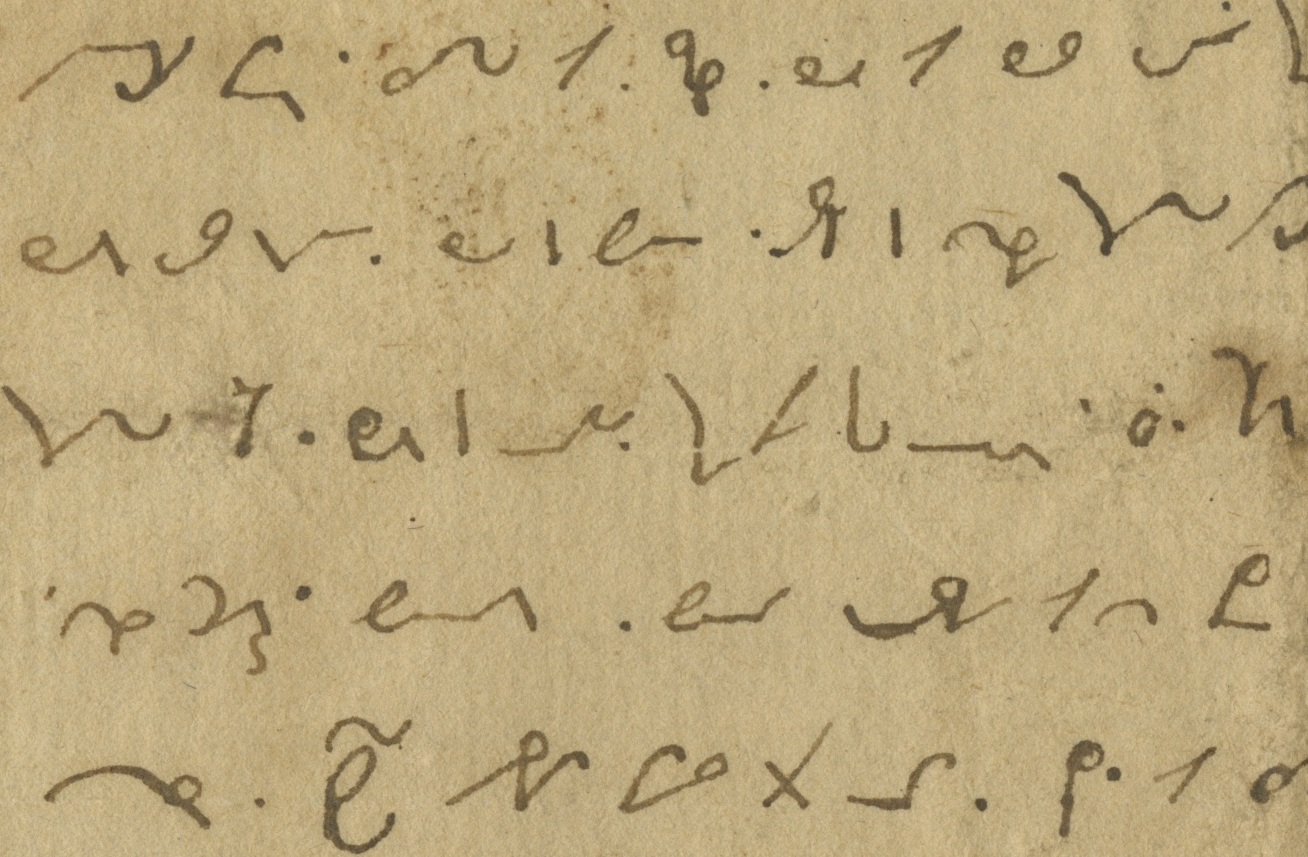 In the McDowell family papers (MSS 91), there’s a letter from John Stuart to Andrew Reid, written in 1790. The contents of the letter is fairly mundane – Stuart has enclosed some promissory notes from people living in the same county as Reid, and wants Reid to deliver the notes to the sheriff for collection (and in one case, to bring a lawsuit agains
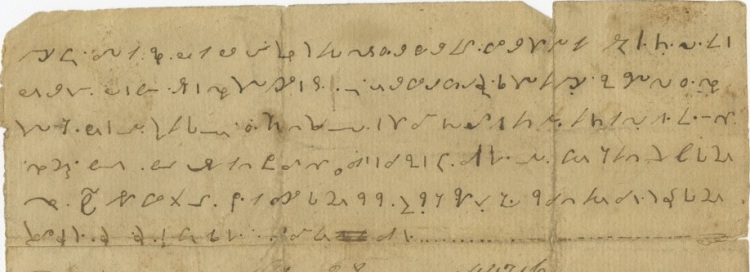
t the individual). On the back of the letter is about a paragraph a text written in an unknown script.
The KHS Special Collections & Library staff has made guesses as to what langu
 age this text might be, but without success. Upon first glance we thought it was Greek, but in looking at the Greek alphabet online, the characters do not seem to match. We went through the same process with Hebrew. We even considered Phoenician, which was in use from about 1000 B.C. to 200 A.D. and which is a parent alphabet to Greek, Hebrew, Arabic, and Latin.
One of our first inclinations gravitated toward shorthand, but this document pre-dates several common forms of shorthand used in the U.S. at this time. If you consider the various common forms (Pitman, Gregg, etc.), this looks similar, but something is not quite right.
Do you have any idea what this script might be? Why would someone have written a message like this on the back of an ordinary letter? Even though the writing appears to be period with the overall letter, perhaps it was added at a later date? Even a few decades from 1790 could make a huge difference in shorthand availability. We would love some more information! To view the full letter, visit the Digital Collections Catalog: MSS 91 Letter from John Stuart to Andrew Reid, 3 March 1790
free sample just need to keep in mind that the that nothing will transform.