
A Taste from the Past: Ellen Wingate Sawyier’s Frankfort Cookbook
Would you be interested in Strawberry Acid Royal? This simple strawberry syrup recipe from the nineteenth century, consisting of ripe strawberries, spring water, citric acid, and sugar, was a popular one among Victorian Americans who adored sweet treats. Such syrups were most often used to make refreshing summer beverages, or what Catherine Esther Beecher (sister of Harriet Beecher Stowe) labeled as “Temperance Drinks” in her book Miss Beecher’s Domestic Recipe Book (1846).1
I found this recipe in an interesting cookbook when searching the Kentucky Historical Society’s (KHS) library catalog. There was no singular author or publisher’s information, and the book was simply titled “Frankfort Cook Book.” Even the date of the book’s creation was unclear. The lack of information was intriguing though, and I wanted to know more about this book, who created it, and why. So, I pulled the physical copy from our closed stacks. At first glance, it seemed like a common leather-bound volume, typical of the mid-nineteenth century. The handwriting was not particularly striking, but then I took a closer look. The first page had the name, Ellen Sawyier, written on it, and as I looked further into the book, the scribbled signatures of Lillian Sawyier and Henry Sawyier were also recorded.
Consulting with my colleagues and comparing this book to other items in the Sawyier family scrapbooks housed at KHS, we were able to identify the creator of this work. It was not just a Frankfort cookbook, but Ellen Wingate Sawyier’s personal cookbook.
Ellen Wingate Sawyier was born on June 23, 1839, to Henry Wingate and Penelope Hart Anderson Wingate. A Frankfort resident, she likely began compiling her cookbook soon after her marriage to Nathanial J. Sawyier in 1861. Such recipes were needed because Ellen and Nathaniel would welcome six children into their lives during the course of their marriage: Lillian Sawyier Hill, Henry Sawyier, Paul Sawyier, Natalie Sawyier Bentz, and Mary Campbell Sawyier Niess-Waner, and Robert Wingate Sawyier.2 Kentuckians might know Paul from the many beautiful watercolor portraits that he painted of the commonwealth’s natural landscape during his illustrious career as an impressionist painter. Perhaps a young Paul Sawyier enjoyed many of the recipes found in Ellen’s cookbook.
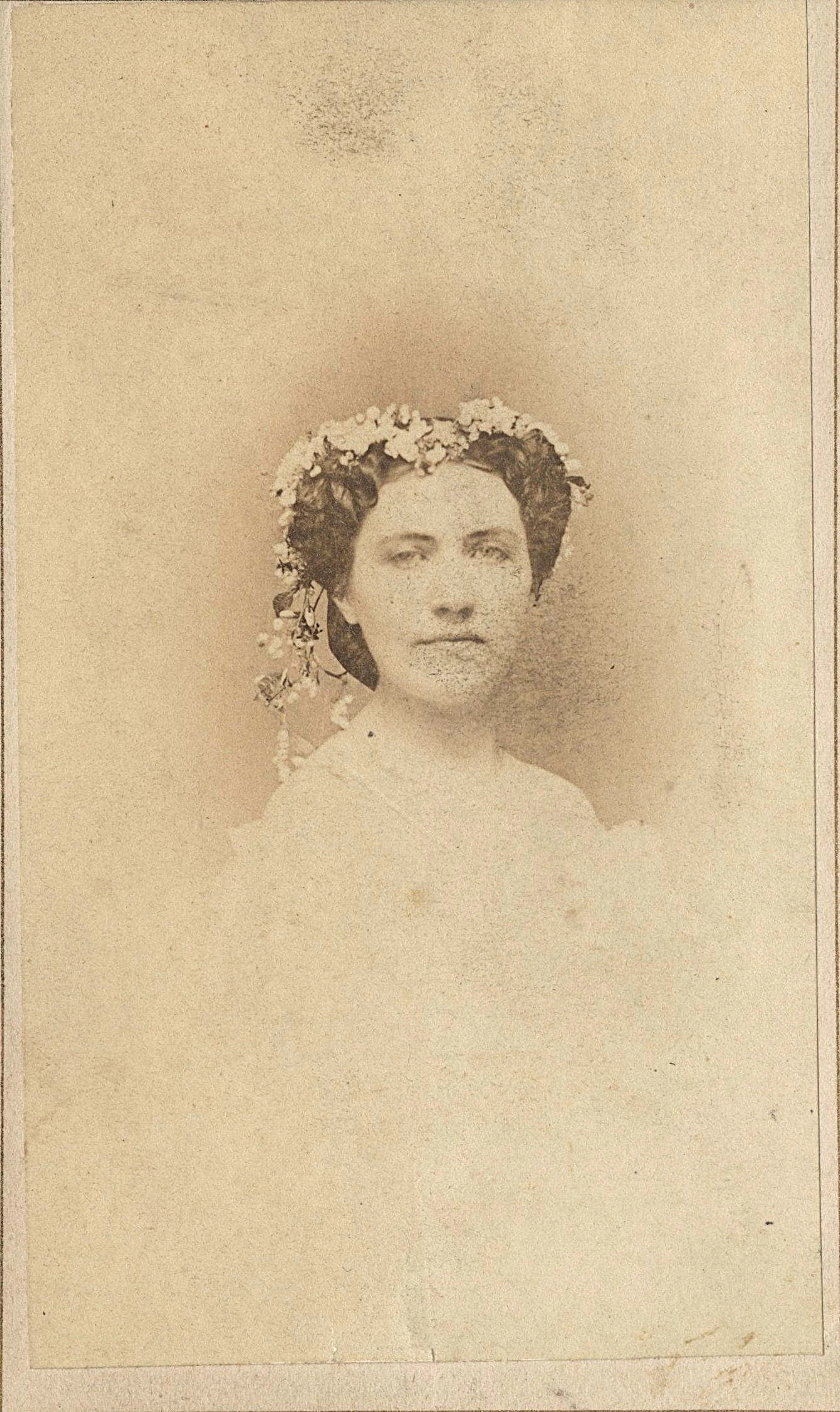
Albumen Print of Ellen Wingate Sawyier in Her Wedding Gown, ca. 1861. MSS 172, Box 1, Sawyier Family Scrapbook, Kentucky Historical Society, Frankfort.
This cookbook, however, was more than a compilation of the Sawyier family’s culinary traditions. Its recipes consist of culinary secrets and practices that Ellen collected from her friends in Frankfort between 1861 and 1908. In total, Ellen’s cookbook included recipes from over thirty prominent families in Frankfort, such as the Wingates, Todds, Duvalls, and Chinns, demonstrating the Sawyiers’ standing in the community and the depth of their social circle.
While the book was written for practical purposes, the recipes that appear on its pages offer insights into the culinary landscape of Frankfort, and Kentucky broadly, during the mid-to-late nineteenth century. Moreover, the book offers a glimpse into the nineteenth century culture of domesticity and the expectations of womanhood.
Cookbooks were hardly a new concept by the nineteenth century. Some of the first cookbooks were published in the fifteenth century, and the idea of recipe keeping has been traced back to the Babylonian era.3 The first American cookbook published was American Cookery, by Amelia Simmons, which appeared in 1796. Other influential works published after this include The Virginia House-Wife (1824), by Mary Randolph, and The American Frugal Housewife (1828), by Lydia Maria Child. The recipes that appear in these early books were a product of the landscape the authors inhabited and the ingredients immediately available to them.
Ellen’s recipes certainly reflect the foodscape of nineteenth century Frankfort and broader Kentucky. For example, Ellen’s Woodford Pudding recipe is a Kentucky creation, while Black Cake was popular across the United States during the nineteenth century. Emily Dickinson even had her own recipe for it.4 Ellen also wrote out recipes for macaroni with cheese, and fine Italian wine in her book, demonstrating her appeal to certain international foods and dishes in addition to local ones. Pickles, catsup (ketchup), cakes, and other desserts feature prominently in the cookbook, perhaps signaling what was popular or at least Ellen’s personal preferences.
During the mid-nineteenth century, worldwide industrial transformations changed the face of how and what people consumed, providing individuals with access to foods and ingredients that were previously inaccessible. One such item was lemons, a previously rare and difficult fruit to obtain but one which had grown in production and popularity during the nineteenth century. Other recipes in Ellen’s book call for box gelatin or “soda,” presumably baking soda. Sodium bicarbonate, used as a leavening agent, and box gelatin were not widely available until the late 1840s.5 Of course, these ingredients, as well as others that appear in the cookbook, such as chocolate, despite their increased availability, were only consistently accessible to upper-class residents given the cost. To a degree then, many of the recipes that appear in Ellen’s cookbook were class restrictive.
The cookbook also provides insights into Victorian gender roles and the domestic responsibilities of women in nineteenth-century Kentucky. For starters, female family members, friends, and household servants authored most of the recipes present in the book. There are scant examples of recipes offered by men, suggesting that men, even servants, hardly bore the responsibility of cooking. Indeed, during the nineteenth century women were primarily responsible for cooking meals and men typically only cooked in very specific contexts. There are exceptions in Ellen’s cookbook, such as a recipe offered by a “Uncle Washington.” As Ellen did not have a relative by this name, this individual likely worked for, or may have been enslaved by, her family.
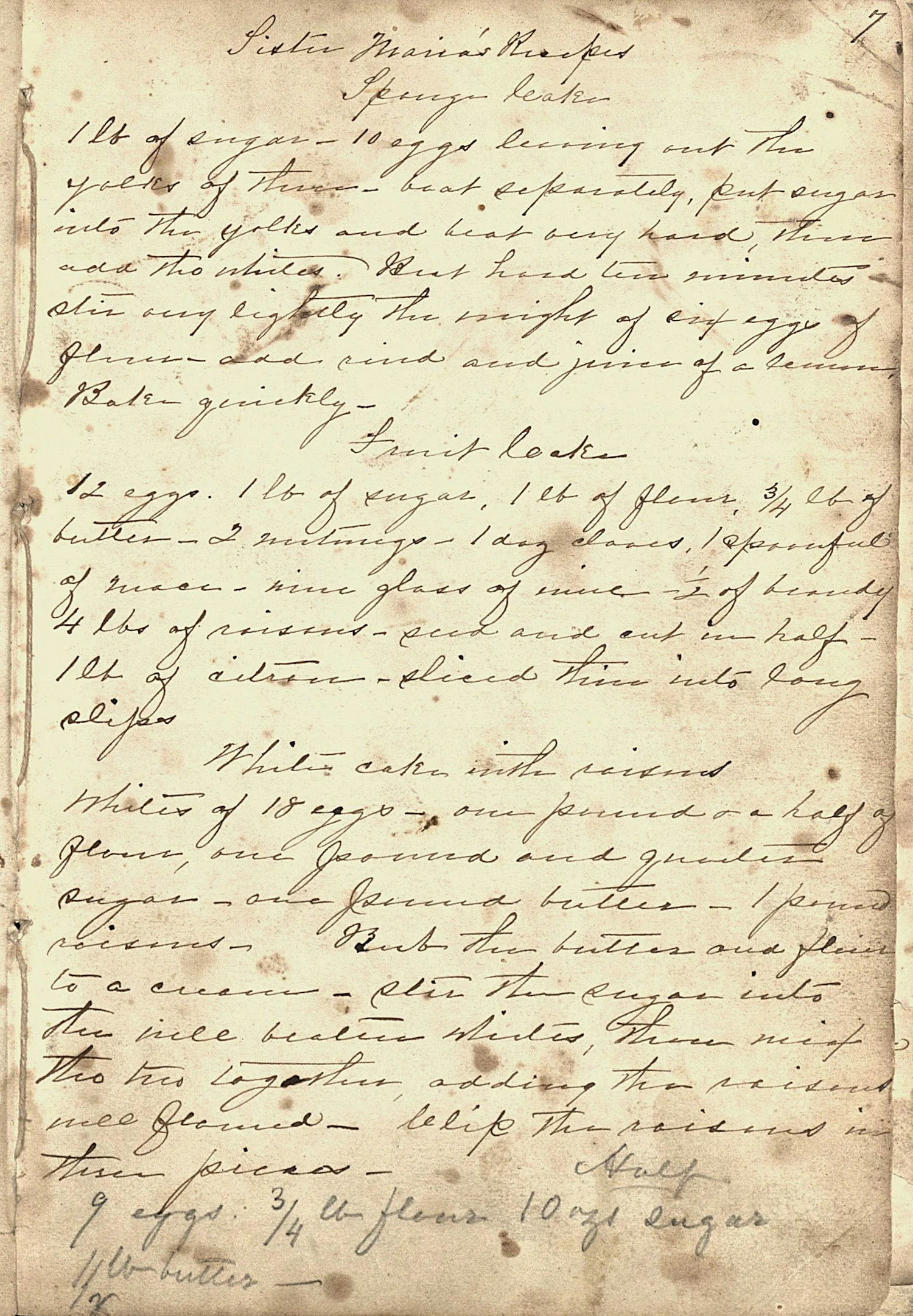
Cake Recipes from Ellen Wingate Sawyier's Frankfort Cookbook, ca. 1861–1908. SC77 FF1 001, Ellen Wingate Sawyier Recipe Book, Kentucky Historical Society, Frankfort.
Ellen’s cookbook is not only filled with recipes. It also consists of instructions for preserving eggs, hair perfume, and other home remedies. Such inclusions demonstrate that cookbooks were also important sources of practical knowledge for women carrying out their domestic responsibilities. What is more, they reflected decades of knowledge passed down by grandmothers and mothers to the next generation of women in their families.
In addition to the compendium of inherited knowledge present in the Frankfort cookbook, many recipes were created in connection with specific historical moments. The book’s “Buena Vista Cake” was likely created sometime after the Battle of Buena Vista, which occurred in 1847 during the U.S.–Mexico War. Granted, its exact creation date is unknown. Kentuckians today might recognize Buena Vista Cake as an ancestor to the classic Kentucky Butter Cake, a simple recipe of milk, butter, sugar, and sifted flour.
Overall, Ellen Sawyier’s Frankfort Cookbook is an important treasure housed at the Kentucky Historical Society. It is a valuable resource for those interested in “rediscovering” Kentucky’s culinary history and a means by which to peek into the everyday life of Frankfort’s upper-class citizenry during the nineteenth century. By their own hands, we can see what ingredients were available to them, what recipes interested them, and how those recipes were influenced by the world around them. It also shows how nineteenth century Frankfort residents interacted with each other and those they employed. In essence, Ellen’s recipe book gives us a “taste” of the past and an opportunity to experience it firsthand.
Additional References:
John Van Willigen, Kentucky Cookbook Heritage: Two Hundred Years of Southern Cuisine and Culture (The University Press of Kentucky, 2014).
Megan J. Elias, Food on the Page: Cookbooks and American Culture (University of Pennsylvania Press, 2017).
Jessamyn Neuhaus, Manly Meals and Mom’s Home Cooking: Cookbooks and Gender in Modern America (Johns Hopkins University Press, 2003).
NOTES
[1] Catherine Esther Beecher, Miss Beecher’s Domestic Recipe-Book: Designed as a Supplement to the Treatise on Domestic Economy (Harper & Brothers, 1862), 186.
[2] Sawyier Family Scrapbook, 1860–1900, MSS 172, Kentucky Historical Society, Frankfort.
[3] Ashley Winchester, “The World's Oldest-known recipes decoded” BBC, 4 November 2019, https://www.bbc.com/travel/article/20191103-the-worlds-oldest-known-recipes-decoded.
[4] Leslie Landrigan, “Black Cake, A Christmas Treat Emily Dickinson Loved to Bake,” New England Historical Society, https://newenglandhistoricalsociety.com/black-cake-a-christmas-treat-emily-dickinson-loved-to-bake/.
[5] Alex Cohen, “More Than Just a Dessert: America's Gelatinous History,” Virgina Tech Special Collections and University Archives Online, Blacksburg, https://digitalsc.lib.vt.edu/exhibits/show/gelatine/generalhistory; Ben Panko, “The Great Uprising: How a Powder Revolutionized Baking,” Smithsonian Magazine, June 20, 2017, https://www.smithsonianmag.com/science-nature/great-uprising-how-powder-revolutionized-baking-180963772/.
